
Reviewed · WALKING TOURS
Best of Porto Private Walking Tour
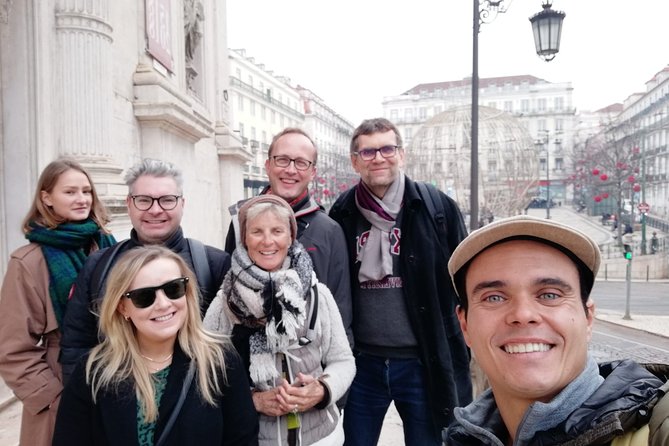
Porto reveals itself best on foot, and this private three-hour walk gives you a useful first look at the city’s churches, tiled façades, grand civic buildings, and old riverside quarter. You begin near the university and finish across the river at Jardim do Morro, with Porto spread before you.
I like the private format, since your guide can adjust the pace and explain things in a way that suits your group. I also like the mix of famous sights and small local pointers. Monica has tailored walks for families, while Gianfranco, Jorge, Caio, Artur, and Filipe have each brought their own style and historical focus.
The main drawback is the walking itself. Porto is hilly, and three hours can feel full when you are moving between many landmarks. The tour also requires good weather, so rain can affect your plans.
In This Review
- Key points to know before you book
- Starting at Fonte dos Leões near Porto’s university
- Porto City Hall and the city’s grand civic face
- Clérigos Tower, the bookshop, and the famous fountain
- Igreja do Carmo and Porto’s blue-and-white tilework
- São Bento Railway Station and the art of arrival
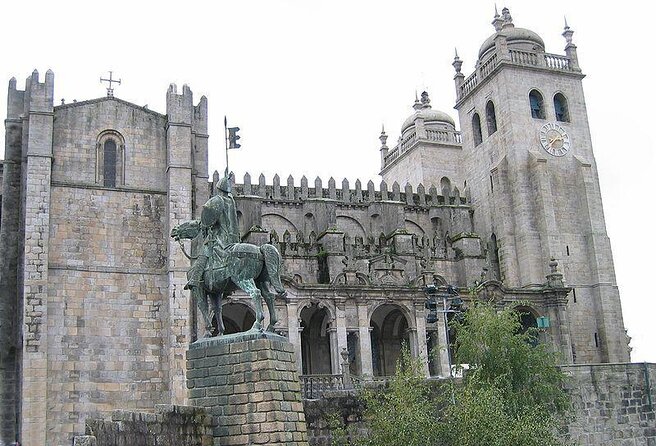
- The oldest churches and the Age of Discoveries
- Crossing toward the Douro by Porto’s remarkable bridge
- The former Stock Exchange and Porto’s commercial power
- Henry the Navigator and the city’s connection to exploration
- Ribeira, Porto’s oldest quarter and UNESCO-listed center
- Finishing at Jardim do Morro with a Douro view
- How the private format changes the experience
- Price, pace, and who gets good value
- My call: book it for your first day
- FAQ
- How long is the Best of Porto Private Walking Tour?
- Where does the walking tour begin?
- Where does the tour end?
- Is this a private tour?
- What language is the tour offered in?
- Can I cancel for a full refund?
Key points to know before you book
- A strong first-day orientation: You see many central sights before deciding where to spend more time.
- A genuinely private experience: Only your group joins, allowing questions, pauses, and some flexibility.
- A handsome finish: The walk ends at Jardim do Morro, where the Douro and Porto make a memorable pair.
- History with a clear theme: Portugal’s Age of Discoveries gives the churches, bridge, old quarter, and monuments a wider story.
- Guides with different strengths: Monica is praised for family-friendly pacing, Gianfranco for an engaging introduction, and Filipe for his academic background.
- A full city walk for the price: At $84.48 per person, value depends on your group size and how much you want personal guidance.
Starting at Fonte dos Leões near Porto’s university
The meeting point is Fonte dos Leões, at Praça de Gomes Teixeira. This puts you in a central part of Porto, close to the university, the Carmo church, the Clérigos area, and several of the city’s most visited streets.
Starting here makes sense. You are not beginning with a long transfer from an outer neighborhood. Instead, you step into the historic center right away, where Porto’s streets quickly shift between formal squares, narrow lanes, churches, bookshops, and steep slopes.
Your guide can use this opening section to explain how Porto grew around the Douro River and how Portugal’s overseas expansion shaped the city. The Age of Discoveries is one of the tour’s main themes, so you will hear more than isolated facts about individual buildings.
The fountain itself is one of Porto’s best-known landmarks. It also gives your group a clear meeting place, which matters in a city where several nearby squares and streets can look alike.
More walking tours in Porto:
- Porto Walking Tour, Lello Bookshop, River Cruise and Cable Car
★ 5.0 · 3,354 reviews - Experience Porto’s Charm: 3-Hour Guided Walking Tour
★ 5.0 · 2,432 reviews - Porto: 3-Hour Guided City Highlights Walking Tour
★ 4.8 · 2,050 reviews
Porto City Hall and the city’s grand civic face
Porto City Hall is the first listed stop, with about five minutes set aside for viewing. Its elaborate design makes a quick stop worthwhile, even if you do not enter.
Here, I would listen for the contrast between Porto’s formal public buildings and the more worn, intimate streets that follow. City Hall represents the city as an institution, while the lanes around the old center show Porto as a lived-in place.
Five minutes is enough for photographs and a short explanation, but not for a detailed architectural study. If grand civic buildings are a special interest, you may want to return later on your own. The value here is orientation: you begin to see how Porto’s center is arranged and how close the major sights are to one another.
Clérigos Tower, the bookshop, and the famous fountain
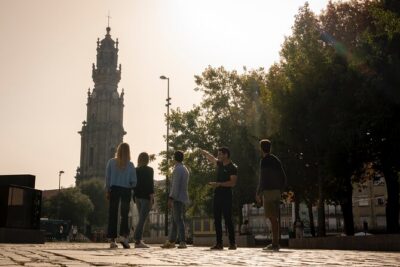
The walk continues through one of Porto’s most popular central areas. Clérigos Tower is described as the city’s most important symbol, and it is one of the key visual markers of Porto.
The tower is especially useful for understanding the city’s vertical character. Porto is not a flat collection of plazas. Its streets rise and fall, and the tower’s position helps you make sense of the center as you move through it.
The route also passes one of the world’s most famous bookshops. The shop is a major attraction in its own right, but the tour is primarily a walking overview, so you should not assume that a full interior visit is included. If you want to browse inside, check the arrangements when booking or plan a separate visit.
You will also see Porto’s best-known fountain. These shorter stops help the walk feel broad rather than narrowly focused on one monument. You get a sense of the city’s public spaces, tourist landmarks, and everyday routes in a compact stretch.
Igreja do Carmo and Porto’s blue-and-white tilework
Igreja do Carmo receives about ten minutes, and this is one of the more rewarding pauses on the route. The church is known for its striking tile-covered façade, a classic Porto sight.
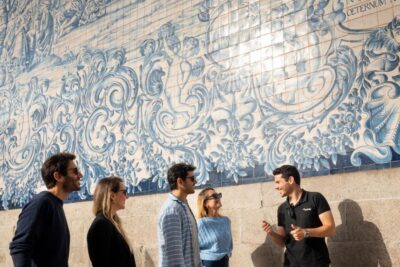
The tilework deserves a slow look. From a distance, it reads as a blue-and-white pattern. Up close, the panels carry scenes and details that reward careful attention. Your guide can help you understand why tile is such a major part of Porto’s visual identity rather than treating the façade as a simple photo stop.
The attraction here is mostly outside, and admission is listed as free. Ten minutes is enough to appreciate the exterior and hear its story, though you will need more time if you want to study every panel or explore the church at leisure.
This is also a good point to watch your footing. Porto’s historic streets can be uneven, and the walk includes slopes. Comfortable shoes are more useful here than stylish ones.
A few more Porto outings to weigh up
- The Unvanquished Tour in Porto City Center
★ 5.0 · 26,497 reviews - From Porto: Douro Valley w/ Boat Tour, Wine Tasting & Lunch
★ 4.7 · 19,061 reviews - Complete Douro Valley Wine Tour with Lunch, Wine Tastings and River Cruise
★ 5.0 · 12,920 reviews - Porto: Six Bridges Cruise
★ 4.2 · 11,680 reviews
São Bento Railway Station and the art of arrival
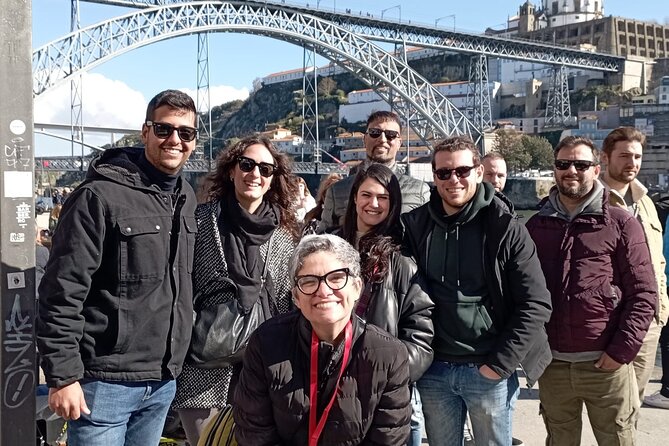
São Bento Railway Station is another ten-minute stop. It is widely regarded as one of the world’s most beautiful stations, and the interior is the reason.
The station’s decorated hall turns an ordinary transport building into a civic gallery. Its tile panels connect daily travel with Portuguese history and national identity. You are likely to get more from this stop if you pause to look at the scenes rather than simply taking a quick photograph.
The station also shows how Porto blends ordinary life with grand design. People use it to catch trains, yet visitors enter to admire the walls. That mixture is part of the pleasure of this walk: the city’s best sights are not all cordoned-off monuments. Some are working places woven into the day-to-day city.
Again, ten minutes is a useful introduction, not an exhaustive visit. If São Bento becomes a favorite, return without the group and give yourself time to examine the panels.
The oldest churches and the Age of Discoveries
The route includes Porto’s most important church and one of its oldest. The exact amount of time at this stop is not specified, so your guide may shape the explanation around your pace and the day’s conditions.
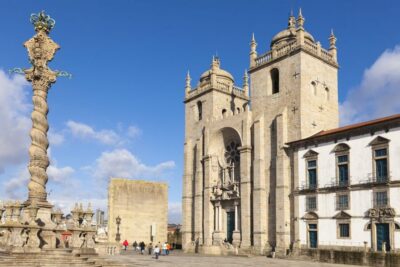
This part of the walk connects religious architecture with Porto’s wider story. Churches here are not just places of worship. They reflect the wealth, power, and public life of the city across different periods.
The Age of Discoveries comes into clearer focus as you move toward the river. Porto’s merchants, sailors, religious institutions, and civic leaders all fit into the story of Portugal’s overseas expansion. A private guide can make those links easier to follow because you can stop and ask how one building relates to another.
I especially value this kind of explanation on a first visit. Without it, Porto’s monuments can feel like a series of attractive but unrelated façades. With context, the city begins to read as a connected story.
Crossing toward the Douro by Porto’s remarkable bridge
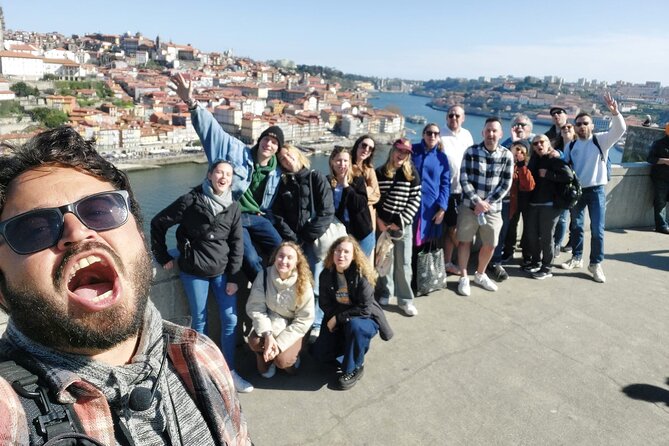
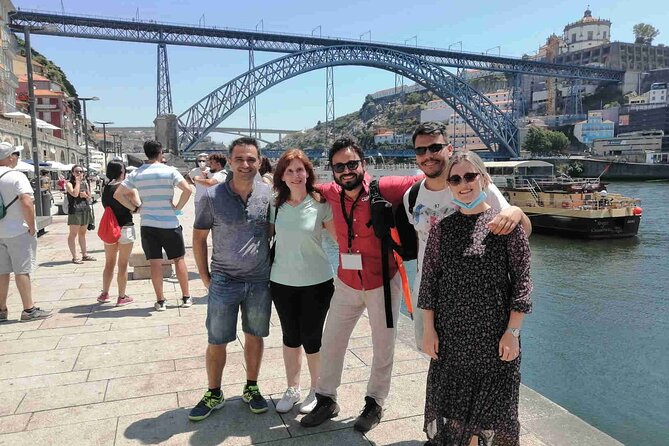
One of the route’s major landmarks is the remarkable bridge built by one of Eiffel’s disciples. The bridge links Porto with Vila Nova de Gaia and gives the walk a clear sense of movement from the historic center toward the river’s southern bank.
The bridge is more than a crossing. It is a piece of engineering that frames the Douro and the hills on both sides. Your guide can point out how the structure fits into Porto’s steep setting and why it has become one of the city’s defining images.
The route ends in Vila Nova de Gaia rather than returning to the starting point. That is useful because you finish in a new part of the metropolitan area and can continue exploring from there. It also means you should think about your plans after the tour. You will not end where you began.
The walking route, hills, and bridge area may feel tiring for anyone who is not used to long city walks. The experience is designed for most people, but it is still sensible to pace yourself and carry water.
The former Stock Exchange and Porto’s commercial power
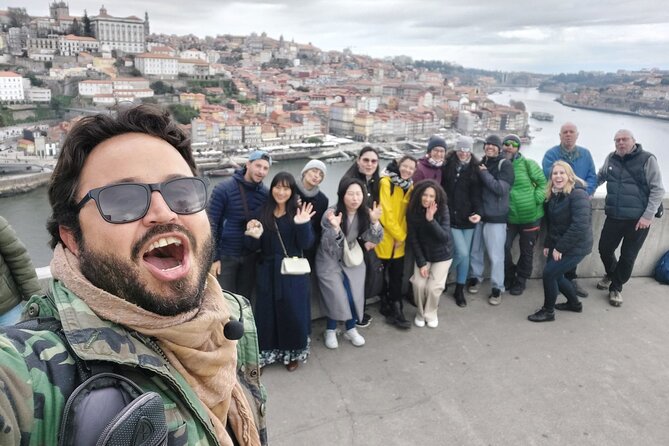
The former Stock Exchange is another important stop. Its presence adds an economic side to the tour’s religious and political themes.
This building helps explain how commerce shaped Porto. The city’s history is not only about churches and explorers. Trade, finance, shipping, and business all helped create the grand interiors and public institutions you see in the center.
The building’s name can sound dry on paper, but it fits the tour well. You are learning why the city had the means and ambition to build such impressive spaces. If your guide is especially interested in architecture or commerce, this may become one of the more rewarding explanations.
The tour does not promise a lengthy interior visit, so treat the stop as part of the walking story rather than a stand-alone museum tour.
Henry the Navigator and the city’s connection to exploration
The route includes the birthplace of Henry the Navigator, identified here as the most important person born in Porto and a central figure in the Age of Discoveries.
This is where the tour’s historical theme becomes personal. Instead of discussing exploration only in terms of ships and maps, you connect it to a specific person and place in Porto.
Your guide can help you sort out the difference between legend, national memory, and historical fact. That kind of conversation is one of the benefits of a private walk. You are free to ask questions rather than simply keeping up with a large group.
The subject can also be handled in different ways by different guides. Artur, whose family connects Porto and Brazil, has brought both Portuguese and Brazilian history into his explanations. Filipe has a PhD in history, so you may prefer him if you want a more academic approach. Guide assignments are not guaranteed, but these names give you an idea of the range of personalities connected with the tour.
Ribeira, Porto’s oldest quarter and UNESCO-listed center
The oldest area of Porto is the walk’s most atmospheric section. It was named a UNESCO World Heritage Site in 1996, and its narrow streets, old buildings, and river-facing setting show why the designation matters.
Here, I would slow down and let the city’s texture do some of the work. The district is not polished into a single postcard view. Its appeal comes from the way the streets climb, bend, and open toward the Douro.
This is also where a private guide can add real value. Monica has been praised for pointing out small local details, historic cafés, and less obvious places to eat. She has also sent restaurant and shop suggestions after walks. You should not book expecting a food tour, but useful local advice can make the rest of your stay easier.
The old quarter is worth revisiting after the tour. Three hours gives you a framework, not enough time to explore every lane. Use the walk to note places you want to return to when you are not watching the clock.
Finishing at Jardim do Morro with a Douro view
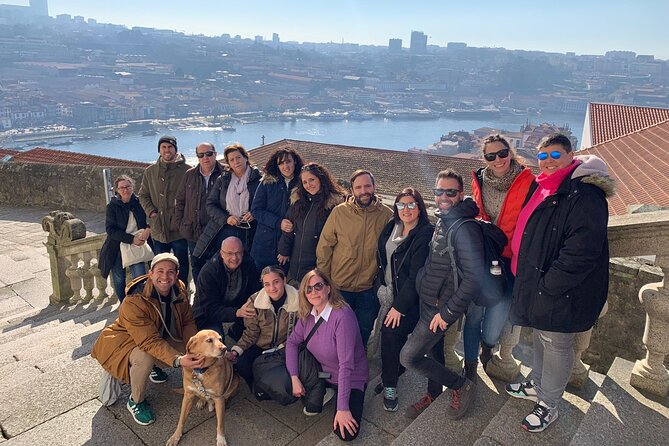
The final meeting point is Jardim do Morro in Vila Nova de Gaia. The tour ends here, with an expansive view across the Douro toward Porto.
This is an excellent finish. After three hours of streets, churches, monuments, and historical explanation, you get a chance to see the city as a whole. The viewpoint helps you connect the hills, bridge, river, and old quarter in one scene.
I also like the practical location of the ending. You can remain in Gaia, enjoy the view, or make your own plans along the river. The tour does not finish with a return transfer, so allow time to decide what you want to do next.
If your schedule is tight, the ending gives you a clear geographical advantage. You are already on the Gaia side instead of having to make a separate trip there later.
How the private format changes the experience
This is not a large group walk. Only your party participates, which gives the guide room to adapt the pace and subject matter.
That matters most for families and small groups with mixed interests. Monica has adjusted her approach for children, keeping the history light while still covering Porto’s main sights. She has also altered routes to suit what a group wanted to see.
You can also ask for more detail. One group enjoyed Artur’s connections between Porto, Portugal, and Brazil. Caio has been described as an Irishman who has lived in Porto for more than ten years, offering a perspective that combines local familiarity with an outsider’s eye. Jorge has been praised for making the city easy to learn on a first day.
You should not assume a particular guide will be assigned unless the provider confirms it. Still, the range of guide styles is a strength. You may get an upbeat storyteller, a history specialist, or someone especially good with children.
Price, pace, and who gets good value
The price is $84.48 per person. For a private three-hour walk, that can be fair value if your group wants personal attention and a useful orientation at the start of a Porto stay.
The value improves for a group that can share the private booking cost. You are paying for the guide’s time, not just a set of stops. Questions, pacing, family needs, and local suggestions all matter more in a private format than in a standard large-group tour.
The walk is less compelling if you prefer to explore alone or want long interior visits. Several stops receive only about five or ten minutes, and the tour covers a lot of ground. Think of it as a city introduction with historical context, not a museum tour or a slow architectural study.
The experience is offered in English, uses a mobile ticket, and is near public transportation. Confirmation is provided at booking. Most people can participate, though the hills and three-hour duration deserve consideration.
Free cancellation is available up to 24 hours before the start time for a full refund. Changes or cancellations inside that window are not accepted for a refund. Because good weather is required, a weather cancellation offers either another date or a full refund.
My call: book it for your first day
I would book the Best of Porto Private Walking Tour for a first full day, especially if you want the city to make sense quickly. It covers Porto City Hall, Clérigos Tower, the famous bookshop, Igreja do Carmo, São Bento Station, old churches, the former Stock Exchange, Henry the Navigator’s birthplace, the old quarter, the bridge, and the Jardim do Morro viewpoint.
Choose it if you value a private guide, enjoy history in manageable portions, and want practical ideas for the rest of your stay. Families should consider requesting a guide suited to children, while history-focused visitors may appreciate asking about a guide such as Filipe or Artur.
Skip it if you want a very slow walk, guaranteed access to every interior, or a route with no hills. For most first-time visitors, though, the combination of major sights, local perspective, and a strong river view makes this a sensible way to get your bearings.
FAQ
How long is the Best of Porto Private Walking Tour?
The tour lasts approximately three hours.
Where does the walking tour begin?
It begins at Fonte dos Leões, Praça de Gomes Teixeira 10, 4050-161 Porto, Portugal.
Where does the tour end?
The tour ends at Jardim do Morro in Vila Nova de Gaia, at 4430-210 Vila Nova de Gaia, Portugal.
Is this a private tour?
Yes. Only your group participates in the private activity.
What language is the tour offered in?
The tour is offered in English.
Can I cancel for a full refund?
You can cancel at least 24 hours before the local start time for a full refund. Cancellations or changes made less than 24 hours in advance are not accepted for a refund. If poor weather causes the provider to cancel, you can choose another date or receive a full refund.
Latest reviews around Porto
- Private Walking Tour, highlights and secrets of Porto★ 3.9 · 3 reviews
- Private Porto Half-Day Tour – Wine Cellars & Cheese Tasting★ 5.0 · 3 reviews
- Portuguese Wine Tasting w Local Cheese & Cold Cuts pairing★ 5.0 · 3 reviews
- From Peso da Régua: Visit 3 wineries, tasting and viewpoint★ 5.0 · 3 reviews
- Porto: Full-Day All-Inclusive Private City Sightseeing Tour★ 4.3 · 3 reviews
- Small Painting Group with a Local Artist in Porto★ 5.0 · 3 reviews
- From Arouca: Paiva River Rafting Adventure – Adventure Tour★ 5.0 · 3 reviews
- Private Tour to Santiago de Compostela and its stunning Cathedral★ 5.0 · 3 reviews
Walking Tours, compared.
Porto Walking Tour, Lello Bookshop, River Cruise and Cable Car
Read our review →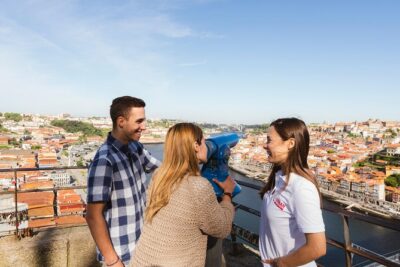
Experience Porto’s Charm: 3-Hour Guided Walking Tour
Read our review →
Porto: 3-Hour Guided City Highlights Walking Tour
Read our review →

Porto: Walking Tour, Lello Bookshop, Boat and Cable Car
Read our review →
Porto: Port and Douro Wine Walking Tour with 9 Tastings
Read our review →Browse the lists this tour appears in