
Reviewed · HISTORICAL TOURS
Porto Historic Center: Small Group Walking Tour & Cathedral
Porto reveals its best story on foot, and this three-hour route links the city’s grand churches, blue-and-white tiles, medieval lanes, and riverfront in one tidy sweep. I like the small group of no more than 10 and the chance to see the Cathedral, São Bento Station, and Dom Luís Bridge without piecing the route together yourself.
I also like the local touch provided by Magda Laires Pinheiro Monteiro, a Porto-born guide who adds restaurant ideas and suggestions for exploring after the tour. The tradeoff is clear: Porto is steep, the walk lasts three hours, and the route is not suited to wheelchair users or anyone with limited mobility.
In This Review
- Key points to know before you book
- Starting beneath Porto’s Town Hall
- Carmo and Carmelitas, Porto’s nearly twinned churches
- Clérigos Church and the tall city landmark
- São Bento Station and Portugal in blue tile
- Crossing Dom Luís Bridge above the Douro
- Serra do Pilar and the city from above
- Porto Cathedral and its gilded interior
- Descending through Porto’s medieval lanes
- Casa do Infante and Porto’s trading past
- Palácio da Bolsa, São Francisco, and Infante Square
- The final arrival at Cais da Ribeira
- Is $81 a fair price for three hours?
- Who should book this Porto walk?
- Should you book it?
- FAQ
- Where is the meeting point?
- How long does the tour last?
- What languages are available?
- Is Cathedral admission included?
- Is the tour suitable for wheelchair users?
- What should I bring?
Key points to know before you book
- São Bento’s azulejos tell the story: The station’s tile panels are more than pretty decoration, with scenes tied to Porto and Portugal.
- The Cathedral ticket is included: You receive skip-the-line access through express security, saving you from arranging this major stop alone.
- Dom Luís Bridge gives you the big view: From its upper level, you can look toward Serra do Pilar, the old city wall, and the Douro.
- Ribeira comes at the end: The route descends through alleys and stairways before reaching Porto’s postcard riverfront.
- Magda adds practical help: Her advice covers places to eat and ways to spend the rest of your time in Porto.
- The hills are part of the deal: Comfortable shoes and a moderate level of fitness matter more here than fancy sightseeing clothes.
Starting beneath Porto’s Town Hall
You meet your guide in front of Câmara Municipal do Porto, Porto’s Town Hall, near the statue of writer Almeida Garrett. Look for the guide carrying a green card with her name.
This is a useful starting point. The square puts you close to several famous sights, but Porto’s center can feel like a jumble of hills and streets when you first arrive. Beginning here gives you a clear route and lets you settle into the city before the steeper sections appear.
The group size matters. With a maximum of 10 people, you should be able to hear the guide more easily than on a large coach-style walk. It also makes it simpler to ask questions, which is especially useful when the tour shifts between architecture, local history, and practical advice.
The guide language options are Portuguese, French, and English. Magda is especially useful if you want more than dates and building names. She was born and raised in Porto, and her advice can help shape the rest of your visit, from restaurant choices to sights worth seeing on your own.
More history walks near Porto:
- Douro Valley: Historical Sites, Wine Experience, Lunch & Cruise
★ 5.0 · 5,133 reviews - Porto: Historic City Center Walking Tour
★ 4.7 · 1,172 reviews - Porto: An Intimate Fado Show in a Historical Tavern
★ 4.8 · 1,093 reviews
Carmo and Carmelitas, Porto’s nearly twinned churches
One of the first stops is the pair of churches known as Carmo and Carmelitas. They sit close together and are often described as Porto’s twin churches, though the story is more interesting than the nickname suggests.
This is a good early lesson in how Porto uses decoration and tight urban space. The churches introduce the religious architecture that appears again at Clérigos and the Cathedral, while also giving you a chance to notice how much character is packed into a few city blocks.
You may also recognize Livraria Lello from nearby. The route includes a guided look at the bookshop area, but the supplied details do not promise entry or a dedicated interior visit. If Lello is high on your list, treat this as a useful orientation rather than a substitute for arranging a separate visit.
That distinction matters because the bookshop is one of Porto’s most sought-after stops. This walk helps you locate it and understand where it fits into the center, but you should not assume that the tour ticket covers admission.
Clérigos Church and the tall city landmark
The 76-meter Clérigos Tower is one of Porto’s easiest landmarks to spot. The tour explains the tower and takes you into the adjoining Clérigos Church, where the brotherhood’s sumptuous setting gives you a closer look at Porto’s religious art.
The church visit adds value because the tower alone is mostly an exterior landmark unless you have separate admission. Here, you get context for the complex and a chance to focus on the interior without spending your short walking tour waiting for a climb.
There is no clear promise that you will climb the tower, so plan on seeing it as a landmark and visiting the church itself. That is not a flaw, but it is an important booking detail for anyone who specifically wants a tower-top view.
Clérigos also helps you get your bearings. From this part of the center, the route moves toward São Bento Station and then across Dom Luís Bridge. You are not simply checking off monuments. You are following the physical shape of Porto, from the upper center down toward the Douro.
São Bento Station and Portugal in blue tile
São Bento Train Station is one of the strongest stops on the route. You visit the grand entrance hall to see its azulejos, the painted ceramic tiles that are a defining feature of Portuguese buildings.
The panels do more than fill a wall with decoration. They show episodes connected to Porto and the country, so the station becomes a visual introduction to Portugal’s past. A good guide can help you understand what you are looking at instead of leaving you to admire a mass of blue and white scenes without context.
I like this stop because it is both practical and beautiful. You do not need to make a special trip to a museum, and you see the station as part of the working city. It is a place where transport, art, and local memory share the same building.
The station also offers a useful pause between the church visits and the longer walk ahead. Still, expect other people in the hall. The space is a popular sight, and a small group helps, but it does not turn the station into a private viewing room.
More walking tours in Porto:
- Porto Walking Tour, Lello Bookshop, River Cruise and Cable Car
★ 5.0 · 3,354 reviews - Experience Porto’s Charm: 3-Hour Guided Walking Tour
★ 5.0 · 2,432 reviews - Porto: 3-Hour Guided City Highlights Walking Tour
★ 4.8 · 2,050 reviews - Porto: Wine Tasting with Tapas Walking Tour
★ 4.4 · 1,541 reviews
Crossing Dom Luís Bridge above the Douro
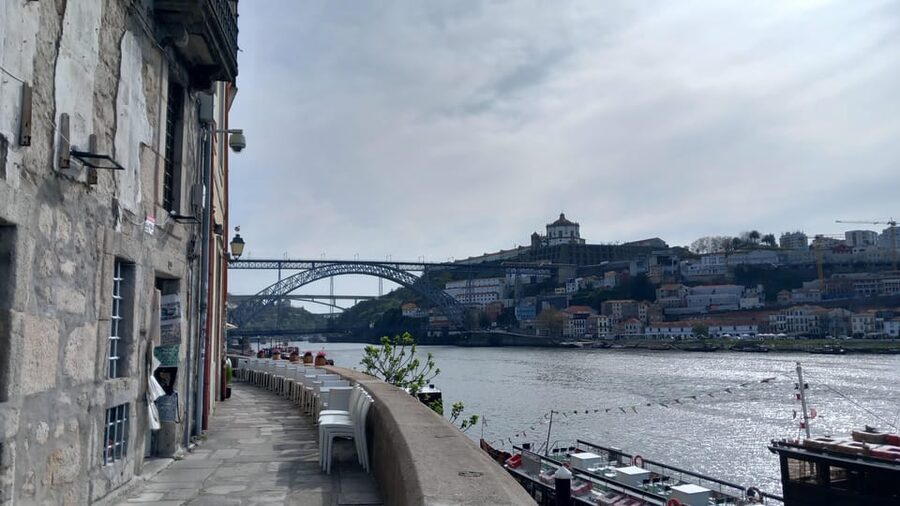
The route then reaches the top level of Dom Luís Bridge for a scenic walk. This is one of the tour’s most rewarding outdoor sections because the bridge gives you a broad view rather than another close look at a church facade.
From up high, you can see toward the Serra do Pilar monastery, the remains of Porto’s Fernandine city wall, and the Douro below. The typical Rabelo boats add a traditional river detail to the view. These boats were used on the Douro in connection with the port wine trade, and their presence helps tie the river to Porto’s commercial past.
The bridge crossing also shows how Porto and Vila Nova de Gaia face each other across the river. You get a stronger sense of the city’s setting here than you can from a narrow street.
Weather will affect this part of the walk. Strong wind, heavy rain, or flood warnings can lead to a cancellation or a rescheduled tour. The operator makes efforts to move the booking when possible, but severe weather can still change the plan.
Serra do Pilar and the city from above
The route includes sightseeing toward Mosteiro da Serra do Pilar, the monastery on the Gaia side of the river. You do not need a long separate visit here to understand why it matters as a viewpoint and a visual counterpoint to Porto’s old center.
This is also where the tour’s route design earns its keep. From the upper bridge, you look across to the monastery and back toward Porto, then later descend into Ribeira. The changing height gives you several views of the same city from different angles.
I would pay attention to the guide’s orientation at this point. The old wall, the river, the bridge, and the monastery can be difficult to connect when you are seeing them one at a time. A local guide can turn the view into a readable map.
Porto Cathedral and its gilded interior
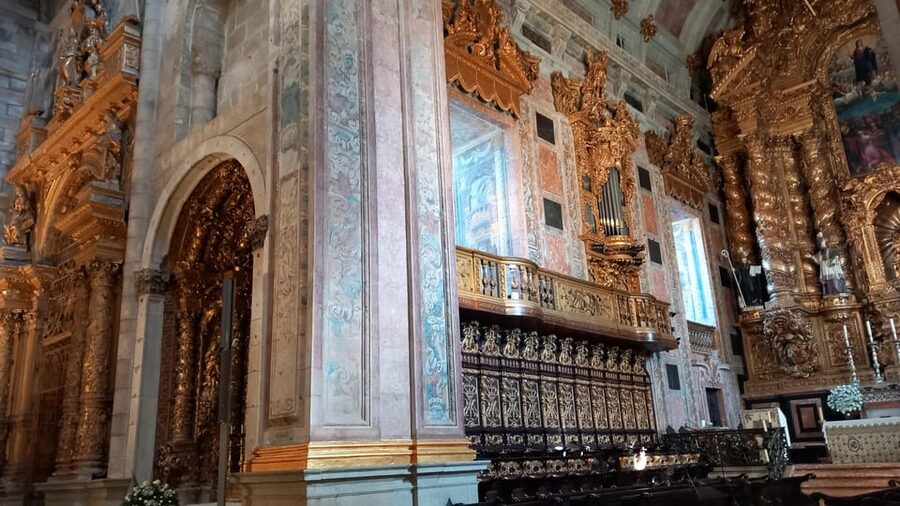
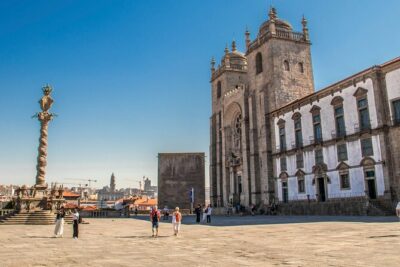
Porto Cathedral, or Sé do Porto, brings the tour to one of its main indoor sights. Its Romanesque exterior is comparatively stern, with solid lines that reflect the building’s medieval character.
Inside, the mood shifts. The gilded woodwork and altarpiece give the Cathedral a more elaborate feel than its stark exterior suggests. This contrast is part of what makes the visit worthwhile. Porto often places serious, heavy stone beside highly detailed religious decoration.
Entry to the Cathedral is included, with skip-the-line access through express security. That is a real convenience during busy periods, since you do not have to arrange the ticket separately or spend part of a three-hour walk sorting out admission.
The Cathedral is closed on Christmas Day and Easter Day, so the tour cannot operate on those dates. It is also worth remembering that the Cathedral is not an easy stop for anyone dealing with steep streets, stairs, or uneven walking conditions.
Descending through Porto’s medieval lanes
After the Cathedral, the route heads downhill into the Ribeira District. This is where Porto begins to feel less like a list of monuments and more like a lived-in old city.
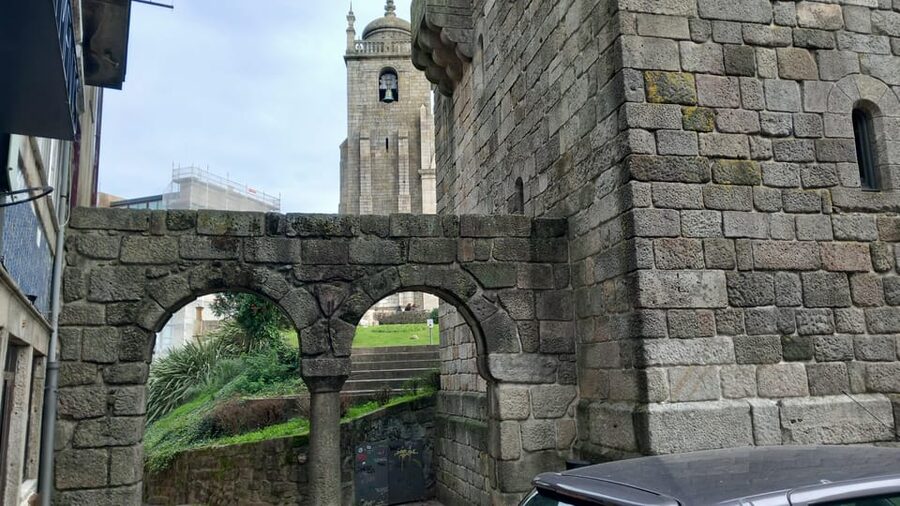
You walk through a tangle of medieval alleys and stairways toward Cais da Ribeira. The descent is scenic, but it is not gentle in every place. Good shoes are essential, and you should be ready for changes in level rather than expecting a flat promenade.
The narrow streets are part of the appeal. They show how the old center developed before modern traffic and wide avenues shaped city travel. At the same time, tight lanes can slow a group down, especially when the area is busy.
This portion rewards patience. Porto is not polished into a single neat view. Its character comes from abrupt corners, worn steps, changing elevations, and buildings from several periods sharing the same small spaces.
Casa do Infante and Porto’s trading past
Near the river, the tour explains Casa do Infante, the old Royal Customs House. This stop connects Porto’s streets to trade and the Age of Discoveries.
The customs function is important because it puts the riverfront in practical terms. The Douro was not simply scenery. It supported shipping, business, taxation, and the movement of goods. Understanding that role gives the later views of the river more meaning.
The route does not treat the old center as a collection of attractive facades only. It links buildings to work, money, faith, and movement. That is one reason a guide-led walk can be more useful than a quick self-guided circuit, especially on a first visit.
Palácio da Bolsa, São Francisco, and Infante Square
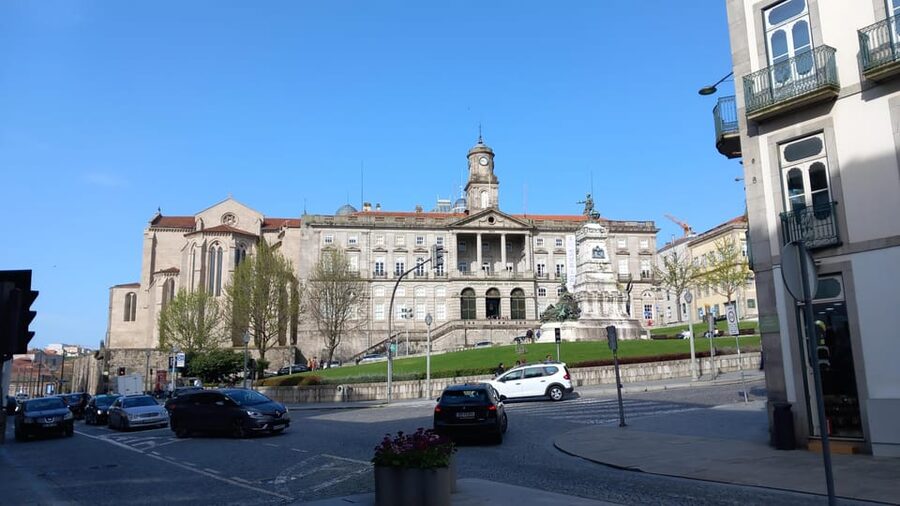
At Praça do Infante D. Henrique, you see several important buildings close together. Palácio da Bolsa, the Church of São Francisco, and Ferreira Borges Market each represent a different side of Porto.
Palácio da Bolsa brings in commerce and civic pride. São Francisco Church is known for its heavily decorated interior, and its presence adds another religious landmark after Clérigos and the Cathedral. Ferreira Borges Market gives the square a more public, everyday character.
The square also helps explain how Porto’s old center grew around trade and institutions. You are near the river, but the buildings point to a city that dealt with merchants, religious orders, civic bodies, and visitors arriving by water.
The supplied route describes these sites as guided stops, but it does not promise interior entry to Palácio da Bolsa, São Francisco Church, or Ferreira Borges Market. Think of this part as an informed walking introduction. If you want a full indoor visit to any one of them, check separately before booking.
The final arrival at Cais da Ribeira
The walk ends at the riverfront in Ribeira, where the view becomes the classic Porto scene. Colorful and varied buildings rise above the Douro, the bridge frames the river, and the old city presses close to the water.
This is a satisfying finish because the route has moved from the upper town down to the river instead of dropping you at the postcard view at the start. By the time you reach Cais da Ribeira, you have a better sense of how the steep streets connect the city’s churches, station, bridge, and trading quarter.
It is also a practical ending. You can continue exploring the waterfront afterward, use the guide’s food suggestions, or make your way to another part of the city. Magda’s advice about restaurants and independent sightseeing is a useful bonus, especially if this is your first day in Porto.
Food and drinks are not included, so plan on arranging those yourself. The tour also does not provide hotel drop-off. This is a walking experience, not a package with transport.
Is $81 a fair price for three hours?
At $81 per person, this is not Porto’s cheapest walking tour. The value depends on how much help you want with the route and the main admission point.
You receive a live guide, a maximum group size of 10, and entry to Porto Cathedral with skip-the-line security. You also cover a large section of the historic center, including São Bento Station, Clérigos Church, Dom Luís Bridge, the Cathedral, medieval lanes, Casa do Infante, and the Ribeira area.
I think the price is easier to justify if you are new to Porto, want historical context, and prefer a compact first-day orientation. It is less attractive if you already know the center, plan to visit only one or two sights, or are happy to walk without explanations.
Magda’s practical suggestions add another layer of value. Direct advice about food and later sightseeing can save you time after the tour, though no guide can guarantee that every restaurant recommendation will suit your taste or budget.
The booking terms are flexible: you can cancel up to 24 hours before the tour for a full refund, and you can reserve now and pay later. Starting times vary, so you need to check availability for your chosen date.
Who should book this Porto walk?
This tour suits you best if you want a first look at Porto’s historic center without spending a full day on formal sightseeing. It packs together the city’s essential landmarks and gives you a route that makes geographic sense.
It is also a good choice for anyone who likes asking questions. The small group makes conversation easier, and Magda’s style includes advice for the rest of your stay, not just information about the building in front of you.
You should think twice if hills are a serious problem. The walk lasts three hours, includes steep streets and stairways, and is not suitable for people with mobility impairments or wheelchair users. Large bags and luggage are not allowed, and electric wheelchairs are specifically excluded.
Wear comfortable shoes and clothes. Porto rewards sturdy footwear far more than fashionable footwear, especially once the route heads downhill into Ribeira.
Should you book it?
Book this tour if you want Porto’s major sights explained in one small-group walk, with Cathedral entry and a strong mix of indoor stops, city views, and old streets. The strongest reasons are São Bento’s tile panels, the bridge crossing, the Cathedral ticket, and Magda’s useful local advice.
Skip it if you prefer a slow, self-guided day or if steep walking will make three hours uncomfortable. For most fit visitors on a first stay, though, the route offers a sensible introduction to Porto and leaves you at Ribeira with the rest of the city still open to explore.
FAQ
Where is the meeting point?
Meet in front of Câmara Municipal do Porto, Porto’s Town Hall, beside the statue of writer Almeida Garrett. The guide is identified by a green card with her name.
How long does the tour last?
The walking tour lasts three hours. Starting times vary, so check availability for your chosen date.
What languages are available?
The live guide is available in Portuguese, French, and English.
Is Cathedral admission included?
Yes. Entrance to Porto Cathedral is included, with skip-the-line access through express security.
Is the tour suitable for wheelchair users?
No. The tour is not suitable for people with mobility impairments or wheelchair users. Electric wheelchairs are also not allowed.
What should I bring?
Bring comfortable shoes and comfortable clothes. Luggage and large bags are not allowed, and food and drinks are not included.
Latest reviews around Porto
- Private Walking Tour, highlights and secrets of Porto★ 3.9 · 3 reviews
- Private Porto Half-Day Tour – Wine Cellars & Cheese Tasting★ 5.0 · 3 reviews
- Portuguese Wine Tasting w Local Cheese & Cold Cuts pairing★ 5.0 · 3 reviews
- From Peso da Régua: Visit 3 wineries, tasting and viewpoint★ 5.0 · 3 reviews
- Porto: Full-Day All-Inclusive Private City Sightseeing Tour★ 4.3 · 3 reviews
- Small Painting Group with a Local Artist in Porto★ 5.0 · 3 reviews
- From Arouca: Paiva River Rafting Adventure – Adventure Tour★ 5.0 · 3 reviews
- Private Tour to Santiago de Compostela and its stunning Cathedral★ 5.0 · 3 reviews
Historical Tours, compared.

Douro Valley: Historical Sites, Wine Experience, Lunch & Cruise
Read our review →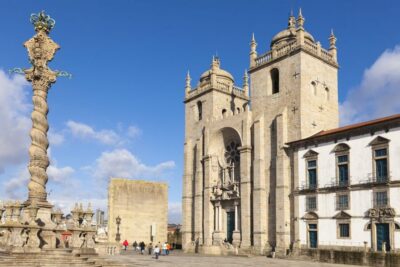
Porto: An Intimate Fado Show in a Historical Tavern
Read our review →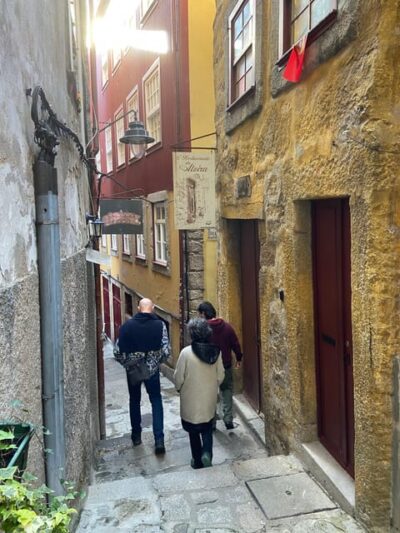
Historic Porto by Private Electric Tuk Tuk to Top Landmarks
Read our review →
Porto:Private Tour of the Historic City in a Classic Ford T
Read our review →
Porto: Douro Valley History & Wine Tour with Cruise & Lunch
Read our review →
Porto Guided Tour to the Historical Center on a Tuk Tuk
Read our review →Browse the lists this tour appears in