
Reviewed · EVENING EXPERIENCES
Porto private night Tour, discover the most iconic attractions
Porto’s best night-tour trick is simple: let someone else handle the hills while you watch the city lights come on. This private outing sweeps from central Porto across the Douro to Gaia, then out toward the ocean, covering far more ground than you could comfortably manage on foot in three hours. Carlos is one of the named guides, and his style combines history with practical tips.
I like the private format, which lets you ask for photo stops or adjust the focus of the evening. I also like the comfortable vehicle, onboard Wi-Fi, water, and refreshments, especially after a day of climbing Porto’s steep streets. The main drawback is the price: at $184.84 per person, it makes the most sense for a small group that values personal service, not for a solo visitor seeking the cheapest introduction.
In This Review
- Key points at a glance
- What the three-hour Porto night tour is really like
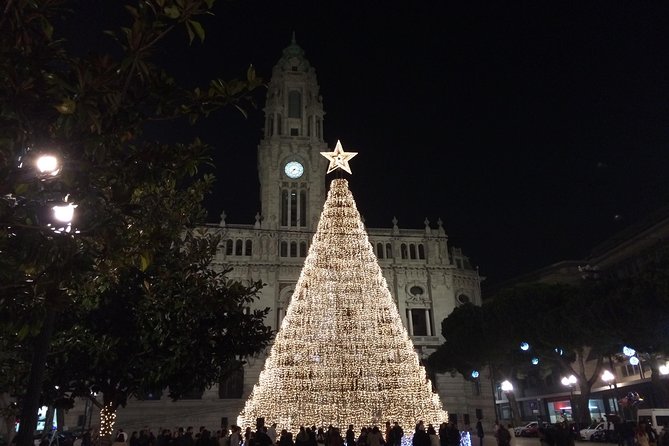
- Avenida dos Aliados and the first look at Porto’s civic center
- Batalha, the Fernandina Wall, and Porto Cathedral
- São Bento Station and Café Majestic
- Carmo, Clérigos, and Livraria Lello
- From the old center to the Douro bridges
- Gaia views, Jardim do Morro, and Serra do Pilar
- The Atlantic coast, Foz, and Matosinhos
- Boavista and a modern finish
- What the price includes and what it does not
- Who will get the most from this private evening
- Should you book it?
- FAQ
- How long does the Porto private night tour last?
- Where does the tour start?
- Is hotel pickup available?
- Is this a private tour?
- What language is the tour offered in?
- Is transportation included?
- Are attraction admission fees included?
- Can I add a Fado show or Port wine experience?
- What is the cancellation policy?
Key points at a glance
- Porto after dark: See major monuments without the daytime crush and catch sunset or evening views from several points.
- A wide-ranging route: The tour links central Porto, Gaia, the Douro bridges, Foz, Matosinhos, and Boavista.
- A private guide and vehicle: Only your group participates, with pickup available from downtown Porto and Gaia hotels and B&Bs.
- Carlos gets strong praise: His punctuality, clear storytelling, flexibility, and effort to make the evening personal are recurring strengths.
- Paid sights cost extra: Entry to Porto Cathedral, Clérigos Tower, Livraria Lello, São Francisco Church, Palácio da Bolsa, and some other sites is not included.
- Optional cultural add-ons: You can add a one-hour Fado show or a 90-minute Port wine cellar visit, but the tour starts two hours earlier.
What the three-hour Porto night tour is really like
This is not a walking tour with a few scenic pauses. It is a private sightseeing drive with short stops, usually around five to 15 minutes each. That distinction matters.
The route includes a long list of Porto landmarks, but three hours is not enough for full visits inside many of them. You will get orientation, stories, exterior views, and time for photographs. If you want to climb Clérigos Tower, browse Livraria Lello, inspect the cathedral cloister, or tour Palácio da Bolsa, you will need to pay the separate admission fees and allow more time.
The vehicle makes the evening practical. Porto’s center is compact but hilly, and the route extends well beyond the old town. You can see the core monuments, cross into Vila Nova de Gaia, look back at Porto from Jardim do Morro, and continue toward the Atlantic coast without arranging several taxis.
The tour is offered in English and includes Wi-Fi, bottled water, refreshments, and a comfortable executive vehicle. Pickup is available from downtown Porto and Gaia hotels and B&Bs. Otherwise, the listed meeting point is Praça da Liberdade 19, near the center of Porto, and the tour returns there.
A few more Porto outings to weigh up
- Porto: Bridges Cruise with Wine Cellar Tour or Sunset Option
★ 4.1 · 2,758 reviews - Porto: Douro River Party Boat with Sunset Option & 6 Bridges
★ 4.7 · 2,040 reviews - Porto: Charming Sailboat Cruise with Port Wine,Sunset Option
★ 5.0 · 1,978 reviews
Avenida dos Aliados and the first look at Porto’s civic center
The evening begins around Avenida dos Aliados, Porto’s broad ceremonial avenue. Its 1920s and 1940s buildings frame the route toward Porto Town Hall, while the Cardosas building closes the avenue on the south side.
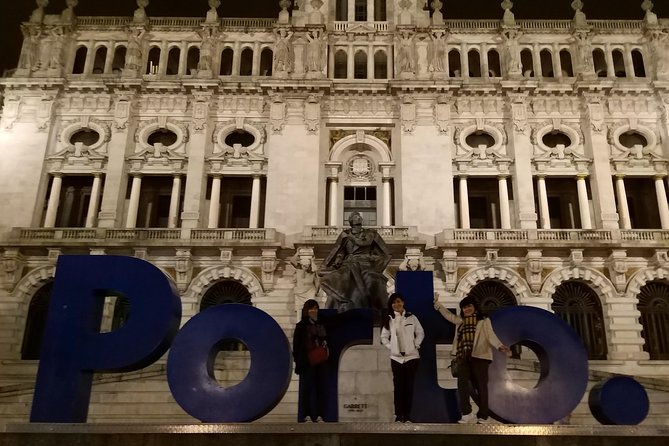
At nearby Praça de D. Pedro IV, you will see the statue of the Liberator, Pedro IV. The square and avenue blend together, so this is a useful first lesson in Porto’s central layout. At night, the open space and formal facades give you a quick sense of the city’s scale before the route turns into narrower streets.
A stop at Mercado do Bolhão adds a more local note. The market dates from 1850 and occupies a neoclassical two-level structure surrounded by four streets. Its stalls focus on everyday goods such as fish, meat, vegetables, and flowers.
The market is listed as a five-minute stop with free admission. At night, you may mainly see the building from outside, depending on opening hours. The important point is its role in Porto’s daily life, not simply its architecture.
Batalha, the Fernandina Wall, and Porto Cathedral
Praça da Batalha carries a name tied to a 10th-century defeat of Porto by Almançor, a Moorish leader. The square was urbanized much later, around 1861, and became an important public space.
The Teatro São João is here. First opened in 1798 for opera and drama, it was destroyed by fire in 1908 and later rebuilt. This brief stop works best as a guide-led orientation point, since the tour does not list a performance or interior visit.
The surviving section of the Muralha Fernandina gives you a glimpse of Porto’s medieval defenses. Construction began in the 14th century under Afonso IV, and the wall was completed during the reign of Fernando in 1409. Much of it disappeared after the fortifications no longer had a military role, but the remaining pieces help explain Porto’s steep, enclosed old center.
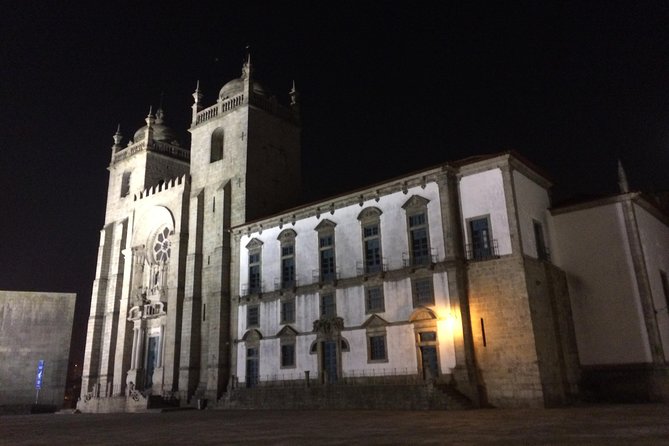
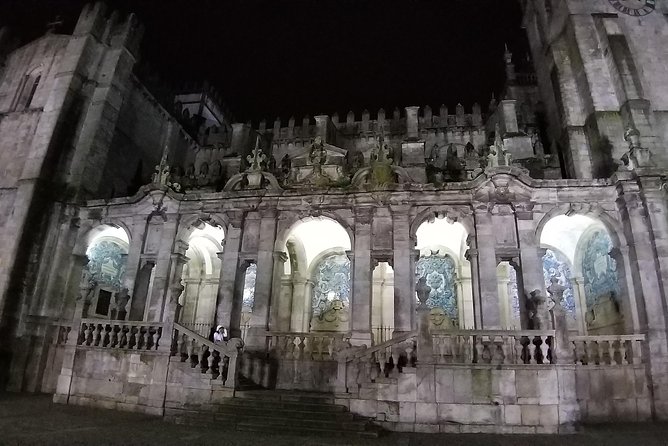
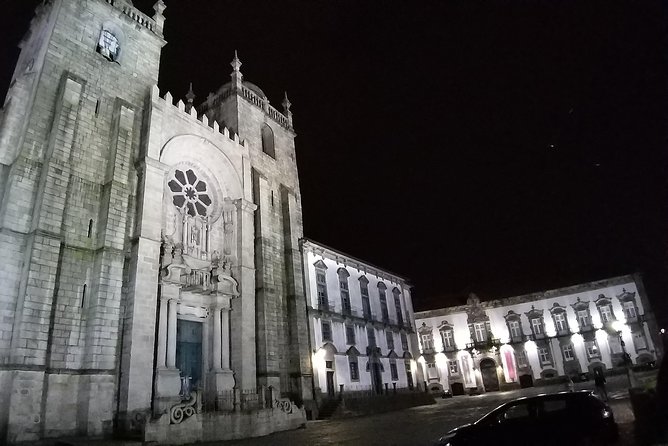
Porto Cathedral follows, with about 15 minutes listed. The cathedral began in the 12th or 13th century and kept its medieval form through later renovations. Look for the Gothic Chapel of St. John the Evangelist, the cloister, the expanded chancel, and the silver altar in the Chapel of the Blessed Sacrament.
Admission is not included. Since the cathedral deserves more than a rushed glance, you should decide in advance if you want a proper interior visit or prefer to use this stop for the outside and the view.
São Bento Station and Café Majestic
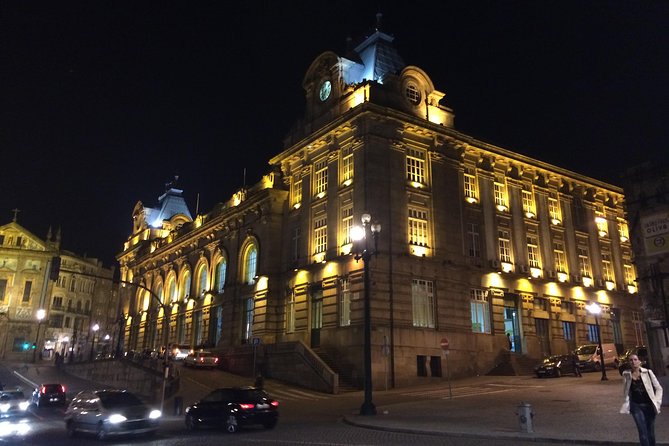
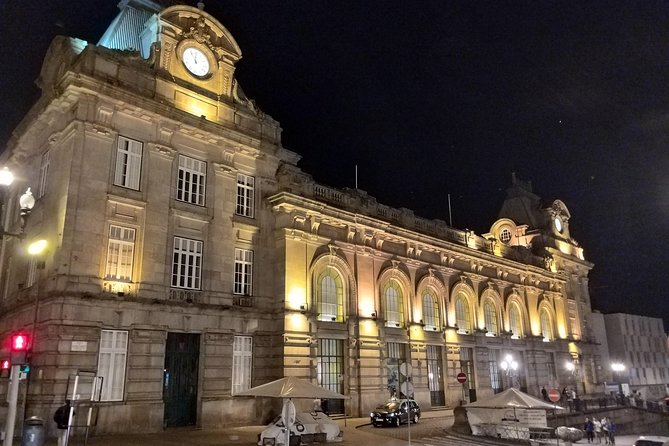
São Bento Railway Station is one of Porto’s essential interiors, even if you only have a few minutes. Built in the early 20th century on the site of a former convent, it combines glass and iron with a grand tiled vestibule.
The highlight is the set of about 20,000 painted tiles by Jorge Colaço. They show transport, history, and scenes from Portuguese life in the region. The station is free to enter, and the listed 15-minute stop is enough for a quick look at the hall if access is open.
Café Majestic brings a different kind of old Porto. Opened in 1921 on Rua Santa Catarina, it reflects the city’s Belle Époque taste with marble, gilded mirrors, and detailed woodwork. It has long been associated with writers, artists, and intellectuals.
The café visit is listed as five minutes, and admission is not included. That is enough for a look, but not necessarily enough for a relaxed coffee or pastry. If sitting inside matters to you, ask the guide if the timing can be adjusted.
Nearby, the Relógio das Galerias Palladium has an ornate clock and carillon. Four historical figures appear on the facade every three hours: Saint John, Prince Henry the Navigator, Almeida Garrett, and Camilo Castelo Branco. The timing may not match your tour, so treat this as a pleasant detail rather than a guaranteed performance.
A different sort of Porto day altogether:
- The Unvanquished Tour in Porto City Center
★ 5.0 · 26,497 reviews - From Porto: Douro Valley w/ Boat Tour, Wine Tasting & Lunch
★ 4.7 · 19,061 reviews - Complete Douro Valley Wine Tour with Lunch, Wine Tastings and River Cruise
★ 5.0 · 12,920 reviews - Porto: Six Bridges Cruise
★ 4.2 · 11,680 reviews
Carmo, Clérigos, and Livraria Lello
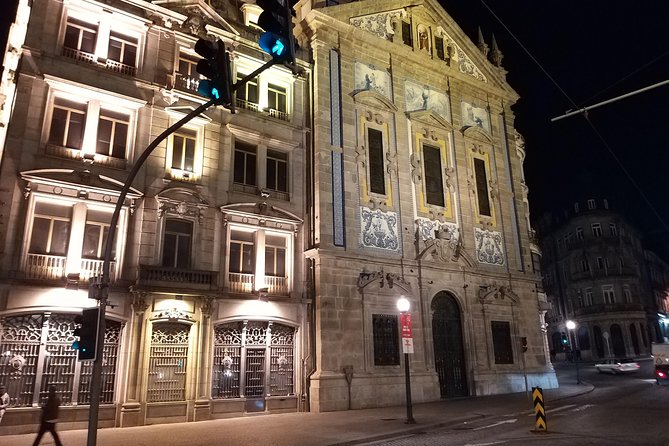
The Carmo area packs several memorable sights into a small space. Igreja do Carmo and Igreja das Carmelitas are Baroque churches with ornate facades, and the famous tiled exterior of Carmo is especially striking.
Between them sits the narrow Casa Escondida, or Hidden House. It was built into the gap between the churches, an ingenious answer to Porto’s tight urban blocks. The stop is free and listed for ten minutes, making it a good place to slow down briefly and look closely.
Clérigos Tower is one of Porto’s defining landmarks. Nicolau Nasoni designed the Baroque tower in the first half of the 18th century. From the top, you can see the city and the Douro River, but reaching the view requires climbing 240 steps.
The tour allows about ten minutes and does not include admission. That makes a tower climb difficult within the scheduled pace. I would treat this as an exterior stop unless you arrange extra time. The tower also appeared in the 2021 film Suicide Squad, a small piece of modern trivia for movie fans.
Livraria Lello is another famous interior that needs planning. The 1906 building has an Art Nouveau facade with Neo-Gothic touches, a dramatic staircase, painted plaster that resembles wood, and a large stained-glass skylight with the bookstore’s motto and monogram.
The listed stop is only five minutes, and admission is not included. You can photograph the exterior and hear the story, but a meaningful bookstore visit requires more time and a separate ticket. If this is a top priority, ask about extending the tour. A two-hour extension is available for €60 per booking.
From the old center to the Douro bridges
The route then shifts from Porto’s old streets to its bridges and riverfront. You may pass the National Museum Soares dos Reis, Portugal’s oldest public museum. It holds fine art, decorative art, and archaeology in the Palace of the Carrancas.
The tour also points out the Electric Car Museum, housed in the former Massarelos central. Its collection includes Porto trams, service vehicles, and an American horse-drawn trolley example introduced in 1872. The Museum of Transport and Communications occupies another 19th-century neoclassical building with facades facing both the river and the city.
These museums are not scheduled as full visits, but they add useful context. Porto’s story is not only churches and wine. Tramways, shipping, transport, and industry shaped the city too.
Igreja de São Francisco is a powerful stop, even if the exterior gives only part of the story. The church began as a Gothic building in the 14th century, then acquired an extraordinarily gilded Baroque interior in the 17th and 18th centuries. Its carved woodwork earned it the nickname Church of Gold.
Look for the Tree of Jesse and, if time and opening hours allow, the catacombs. The church is a National Monument and part of Porto’s UNESCO-listed historic center. Admission is extra, and the scheduled five minutes again suggests a quick orientation rather than a full visit.
Palácio da Bolsa follows. Built in neoclassical style from 1842 on the site of the former Convent of San Francisco, it is now connected with Porto’s Commercial Association. The Arab Room is the famous highlight, with ornate decoration that contrasts with the building’s formal exterior.
The stop is listed for five minutes, with admission extra. That is enough to identify the building and hear why it matters, but not enough for the full guided interior route.
Gaia views, Jardim do Morro, and Serra do Pilar
The bridge sequence is one of the strongest parts of the evening because Porto’s river crossing tells a story of engineering as well as scenery.
You may see the remains of the earlier D. Maria III suspension bridge, opened in 1843 and deactivated after only four years. Only two stone pillars remain. Then comes the D. Luís I Bridge, inaugurated in stages in the 1880s and known for its enormous wrought-iron arch.
The modern Infante Bridge replaced the upper deck of the D. Luís I Bridge for road use, while the upper level now carries a Porto Metro line. D. Maria Pia Bridge, designed by Gustave Eiffel with Théophile Seyrig, opened in 1877 and carried trains for 114 years. Its single-track railway deck rests on a large articulated arch.
You also pass São João Bridge, opened in 1991 to carry rail traffic south from Campanhã station. Together, these crossings show how Porto and Gaia developed around the Douro.
Jardim do Morro is one of the evening’s best photo stops. From this public garden in Gaia, you look across the river toward Porto, with the historic center and bridges arranged below. Sunset is especially valuable here, and several people specifically appreciated seeing the sun drop from different points along the route.
The nearby Monastery of Serra do Pilar adds a historic frame to the view. Its circular church and cloister are unusual in European architecture. Construction began in 1538 for the Order of St. Augustine, and the monastery later served religious, cultural, and military purposes.
Both the garden and monastery stop are listed for about ten minutes. The timing is short, but the viewpoint makes this section feel less rushed than the central-city stops.
The Atlantic coast, Foz, and Matosinhos
After the Douro, the route can continue toward the coast. You may pass the Arrábida Bridge, a reinforced-concrete bridge opened in 1963, and the Fortress of São João Baptista, built to protect the Douro entrance and coastline.
Castelo do Queijo, officially Fort São Francisco Xavier, sits on a rocky rise shaped like a cheese. The 17th-century fort was intended to guard against North African pirates. The stop is listed for ten minutes, but admission is extra.
The coastal run gives you a side of Porto that many compact city tours miss. The promenade and oceanfront area have an upscale feel, and the route includes Matosinhos, the Leixões port, and the sculpture She Changes, often called Anemone.
Janet Echelman’s sculpture is made from a fishing net that moves with the wind, creating a striking link to the sea and to Matosinhos’s fishing culture. Leixões is also an active cruise port, with a cruise pier opened in 2011.
The Atlantic section is a major reason to choose this private drive. It takes you beyond the historic center and gives the evening a change of mood. The tradeoff is time: every coastal stop reduces time available for interiors in central Porto.
Boavista and a modern finish
The route may continue through Serralves, a major cultural complex that combines a contemporary art museum, an Art Deco house, and an 18-hectare park. The house dates from the 1930s and is an important example of European Art Deco.
You will not have time for a full museum or park visit during this three-hour tour, but the guide can point out the complex as part of Porto’s modern cultural side.
Casa da Música provides another sharp change in style. Designed by Dutch architect Rem Koolhaas and opened in 2005, the concert hall is one of Porto’s best-known modern buildings. A five-minute stop is enough to see its bold form and hear how it fits into the Boavista district.
At Praça de Mouzinho de Albuquerque, a 45-meter monument recalls the Peninsular War. Its obelisk and sculptures represent Portuguese and English cooperation against Napoleon’s French armies. This is a good final city stop before returning to the center.
What the price includes and what it does not
At $184.84 per person, this is a premium outing. The cost is easier to justify if you are traveling with family or friends and can use a group discount, since the vehicle, driver, guide, pickup, Wi-Fi, water, refreshments, and insurance are included.
The price does not cover entry to several major sights. That includes Porto Cathedral, Clérigos Tower, Livraria Lello, São Francisco Church, Palácio da Bolsa, Castelo do Queijo, and other paid attractions along the route.
You are paying mainly for the private vehicle, the wide route, and a guide who can adapt the evening. You are not paying for a series of long museum visits. If you want only the old center, a cheaper walking tour may offer better value. If you want Porto, Gaia, sunset views, and the Atlantic coast in one evening, the calculation changes.
You can add a Fado show with Port wine for €20 to €26 per person. That option lasts one hour and is scheduled daily at 18:00 and 19:30. A Port cellar visit focused on Dona Antónia includes five tastings and costs €32 to €41. Both options require the tour to start two hours earlier.
Who will get the most from this private evening
I would choose this tour for a first visit when you want a fast orientation before exploring on your own. It also fits couples, families, and small groups who prefer a private car to steep walks, crowded public transport, or several separate taxi rides.
It is especially useful for anyone who wants to combine city monuments with Gaia and the coast. The route is broad, and the guide can help you decide which places deserve a return visit in daylight.
The tour suits most people, and service animals are allowed. It requires reasonably good weather, since the experience may be canceled in poor conditions. Free cancellation is available up to 24 hours before the start, but changes or cancellations inside that window are not refunded.
The strongest practical benefit is flexibility. Carlos is described as punctual, professional, personable, and willing to ask what you want to see. In wet weather, he has adapted the route, stopped for photographs, and kept the evening enjoyable. That kind of attention matters more on a private tour than a fixed group excursion.
Should you book it?
Book this Porto night tour if you value comfort, personal attention, and a broad route over low cost. It gives you a useful first look at the city, strong Douro and sunset viewpoints, and a rare chance to include Foz and Matosinhos in the same evening.
Do not book it expecting a full tour of every church, tower, museum, and bookstore listed. The short stops are best for exteriors, orientation, and photographs. For the best value, travel with at least two or three people, tell Carlos your priorities at the start, and decide in advance which paid interior you might want to revisit later.
FAQ
How long does the Porto private night tour last?
The tour lasts approximately three hours and ends back at the meeting point.
Where does the tour start?
The listed meeting point is Praça da Liberdade 19, 4000-322 Porto, Portugal.
Is hotel pickup available?
Yes. Pickup is offered from downtown Porto and Gaia hotels and B&Bs.
Is this a private tour?
Yes. Only your group participates in the activity.
What language is the tour offered in?
The tour is offered in English.
Is transportation included?
Yes. Transport is provided in a comfortable executive vehicle with Wi-Fi, bottled water, refreshments, and extra equipment suited to your needs.
Are attraction admission fees included?
No. Admission is not included for several sights, including Porto Cathedral, Clérigos Tower, Livraria Lello, São Francisco Church, Palácio da Bolsa, and Castelo do Queijo.
Can I add a Fado show or Port wine experience?
Yes. A Fado show with Port wine costs €20 to €26 per person, and the Port cellar tour with five tastings costs €32 to €41. Either option requires the tour to start two hours earlier.
What is the cancellation policy?
You can cancel up to 24 hours before the start time for a full refund. Cancellations or changes made less than 24 hours before the experience are not refunded or accepted. If poor weather causes the tour to be canceled, you will be offered another date or a full refund.
Latest reviews around Porto
- Private Walking Tour, highlights and secrets of Porto★ 3.9 · 3 reviews
- Private Porto Half-Day Tour – Wine Cellars & Cheese Tasting★ 5.0 · 3 reviews
- Portuguese Wine Tasting w Local Cheese & Cold Cuts pairing★ 5.0 · 3 reviews
- From Peso da Régua: Visit 3 wineries, tasting and viewpoint★ 5.0 · 3 reviews
- Porto: Full-Day All-Inclusive Private City Sightseeing Tour★ 4.3 · 3 reviews
- Small Painting Group with a Local Artist in Porto★ 5.0 · 3 reviews
- From Arouca: Paiva River Rafting Adventure – Adventure Tour★ 5.0 · 3 reviews
- Private Tour to Santiago de Compostela and its stunning Cathedral★ 5.0 · 3 reviews
Evening Experiences, compared.
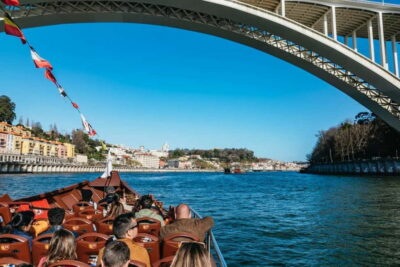
Porto: Bridges Cruise with Wine Cellar Tour or Sunset Option
Read our review →
Porto: Douro River Party Boat with Sunset Option & 6 Bridges
Read our review →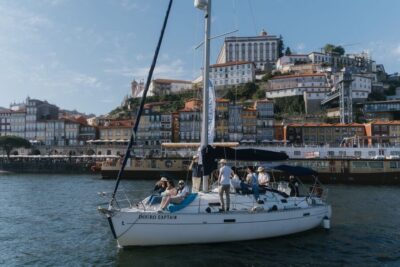
Porto: Charming Sailboat Cruise with Port Wine,Sunset Option
Read our review →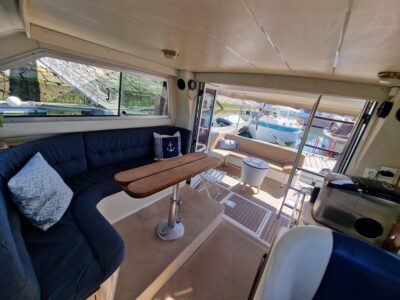
Porto: 6 Bridges Cruise & Port Wine with Sunset Option
Read our review →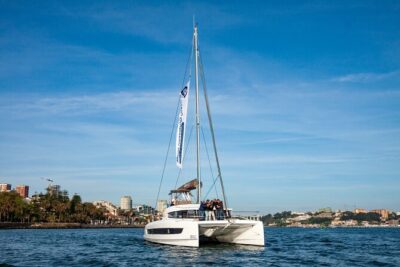
Porto Douro River Cruise With Port Wine – Daytime or Sunset
Read our review →
Porto: Daytime or Sunset Douro River Sightseeing Cruise
Read our review →
Port : 6 Bridges Cruise , Douro River with Sunset Option
Read our review →Browse the lists this tour appears in