Reviewed · PRIVATE
Porto private afternoon tour, discover the most iconic attractions
Porto packs a remarkable amount into a small area, and this private afternoon tour gives you a fast, comfortable look at nearly all of it. In four hours, you move from grand central avenues and tiled churches to the Douro bridges, Gaia viewpoints, the Atlantic coast, and modern Porto.
I like the private vehicle and hotel pickup, especially because Porto’s hills and scattered sights can make a self-guided first outing tiring. I also like the wide range of stops: São Bento’s tile hall, the gold-covered churches, the Clérigos skyline, and the coast all appear in one trip.
The tradeoff is clear: this is a sightseeing sampler, not a slow walking tour. Several stops last only 10 or 15 minutes, and admission to the best interiors costs extra. The optional activities can also push the day’s price well above the advertised $185.43 per person.
In This Review
- Key points at a glance
- A broad introduction to Porto, from Aliados to Bolhão
- Batalha, the old walls, and Porto Cathedral
- São Bento’s tiles and the elegant center
- Carmo, Clérigos, and Livraria Lello
- Porto’s churches, museums, and grand civic rooms
- The Douro bridges and Gaia viewpoints
- From Foz and Matosinhos to modern Porto
- What the $185.43 price really buys
- Who should book this Porto tour?
- Should you book it?
- FAQ
- How long does the Porto private afternoon tour last?
- Is hotel pickup available?
- Is this a private tour?
- Are attraction admission fees included?
- Is transportation included?
- Can I add a Douro cruise, Port tasting, or fado?
Key points at a glance
- São Bento’s 20,000 tiles: See one of Porto’s most memorable interiors without paying an entry fee.
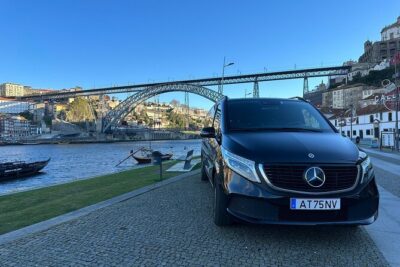
- A private four-hour route: Your group travels alone in an executive vehicle with hotel pickup, Wi-Fi, bottled water, and refreshments.
- Porto’s famous paid sights cost extra: Livraria Lello, Clérigos Tower, Palácio da Bolsa, São Francisco Church, and other entries are not included.
- The route reaches the Atlantic: Along with central Porto, you see Castelo do Queijo, the Foz area, Matosinhos, and Leixões.
- The best views come from Gaia: Jardim do Morro and Serra do Pilar offer strong views toward Porto and the Douro.
- Optional evening add-ons: You can add a private sunset cruise, Port wine tasting, dinner with fado, or a shorter fado show.
A broad introduction to Porto, from Aliados to Bolhão
The tour begins around Avenida dos Aliados, Porto’s grand central avenue. Buildings from the 1920s and 1940s frame the broad space, while the Cardosas building closes the southern end and City Hall anchors the north. In the nearby Praça de D. Pedro IV, a statue honors Pedro IV, known as the Liberator.
This is a useful place to begin because it gives you Porto’s civic face before the route moves into older streets. You can quickly get your bearings among the stone facades, monuments, and sloping roads.
At Mercado do Bolhão, you get a short look at the city’s traditional food market. The building dates from 1850 and uses a striking two-level neoclassical design. Inside and around its four surrounding streets, vendors focus on fish, meat, produce, and flowers.
The scheduled visit is about 15 minutes, so think of this as an introduction rather than a full market visit. If you want to browse stalls, buy food, or watch the daily trade at a relaxed pace, you may wish for more time. Still, it is an important stop because it shows Porto as a working city, not just a collection of monuments.
A few more Porto outings to weigh up
- The Unvanquished Tour in Porto City Center
★ 5.0 · 26,497 reviews - From Porto: Douro Valley w/ Boat Tour, Wine Tasting & Lunch
★ 4.7 · 19,061 reviews - Complete Douro Valley Wine Tour with Lunch, Wine Tastings and River Cruise
★ 5.0 · 12,920 reviews
Batalha, the old walls, and Porto Cathedral
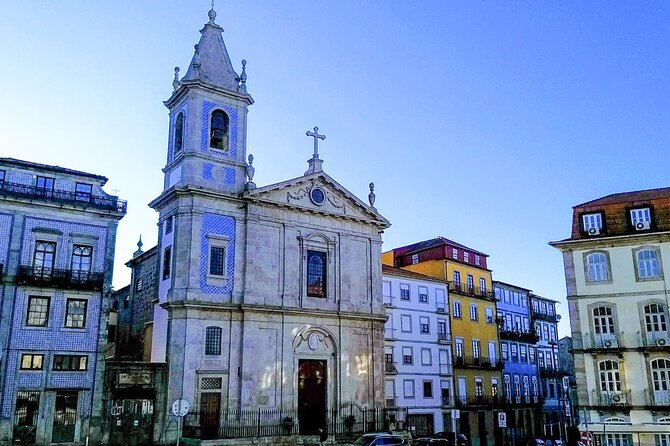
Praça da Batalha links the city center with the upper part of the old town. Its name reaches back to a medieval defeat involving Almançor, a Moorish leader, and the destruction of Porto. The square was urbanized in the 19th century and later became home to the Teatro São João.
The theater opened in 1798 for opera and drama, then suffered a major fire in 1908. You mainly see the square and its surrounding buildings from the vehicle, so the value here is orientation and context rather than a long theater visit.
The route also points out surviving sections of the Fernandine Wall. Construction began in the 14th century under Afonso IV, replacing an earlier wall as Porto expanded. Most of it was torn down in the 18th century after losing its military purpose, leaving only fragments.
At Porto Cathedral, you see a medieval building repeatedly altered from the 12th century through the 20th century. Its Gothic Chapel of São João Evangelista, cloister, enlarged chancel, and silver altar in the Chapel of the Blessed Sacrament are the key details to watch for.
The cathedral visit is listed at about 10 minutes, and admission is not included. That is enough for a quick look, but not enough for a leisurely examination of the cloister or chapels. If religious art and medieval architecture are your main interests, ask the guide how much time can be devoted to the interior.
São Bento’s tiles and the elegant center
São Bento Railway Station is one of the tour’s strongest free stops. The station occupies the site of the former Convent of São Bento de Avé Maria, a 16th-century foundation, but the present building dates from the early 20th century.
Inside, an iron-and-glass structure frames a grand vestibule decorated with about 20,000 painted tiles by Jorge Colaço. The scenes show transport, regional life, and events from Portuguese history. You do not need a train ticket to enter the hall, and 10 minutes is usually enough to admire the main panels.
I would pay close attention to the blue-and-white tile scenes rather than simply snapping a photo and leaving. This is one of those places where a guide’s explanation adds real value, since the images can look decorative until you understand what they represent.
Café Majestic brings a different mood. Opened in 1921 on Rua Santa Catarina, it has marble, gilded mirrors, carved wood, and an Art Nouveau interior linked to Porto’s Belle Époque. You have about five minutes here, and entry is not included.
That short stop is best treated as a look at the facade and a quick sense of the setting. Sitting down for coffee or pastry would require extra time and money. Nearby, the Palladium clock features a carillon and four historic figures that appear on the facade every three hours, so your timing may or may not line up with the performance.
The route then passes the Rivoli Theatre and the former Academy building, now associated with the University of Porto’s rectory and Natural History Museum. These stops help fill in Porto’s cultural center, even though they are mainly exterior views.
Carmo, Clérigos, and Livraria Lello
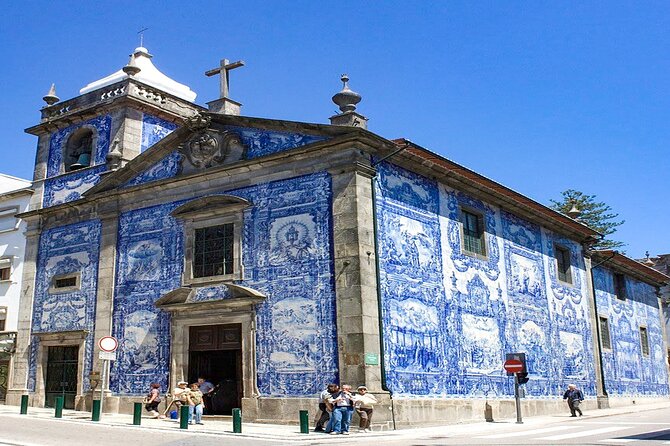
The paired Carmo and Carmelites churches provide one of Porto’s most recognizable architectural scenes. Carmo is known for its exterior tile panel, while the Carmelites church has an ornate facade. Between them is the narrow Casa Escondida, or Hidden House, built into the tight space between the two religious buildings.
The visit lasts about 10 minutes and is listed as free. Look closely at the small house rather than focusing only on the churches. It is a simple but memorable example of how buildings were fitted into Porto’s crowded historic center.
Clérigos Tower is another highlight, though admission costs extra. Nicolau Nasoni designed this Baroque landmark in the first half of the 18th century. The top is reached by 240 steps, and the view takes in Porto and the Douro River.
The scheduled visit is 10 minutes, which is very tight if you plan to climb. The listed skip-the-line tower ticket costs €10 per person. If you want the panorama, confirm that the stop includes enough time for the climb, or consider paying for the ticket and extending the tour by an hour. Each extra hour is listed at €30 per booking.
Livraria Lello is similarly popular and also requires a separate ticket. The bookstore opened in 1906 and combines an Art Nouveau facade with neo-Gothic details. Inside, look for the carved-looking painted plaster, reinforced-concrete staircase, and large stained-glass skylight bearing the store’s monogram and motto.
The Gold Ticket, which includes priority entry and a book, is listed at €16. The visit is timed for about 10 minutes, so this stop favors a quick architectural look. If browsing books matters to you, the time may feel rushed and the additional ticket is worth considering only if the schedule allows more time.
A different sort of Porto day altogether:
- Porto: Six Bridges Cruise
★ 4.2 · 11,680 reviews - Porto: Live Fado Show with Glass of Port Wine
★ 4.8 · 6,498 reviews - Porto: 6 Bridges Douro River Cruise
★ 4.3 · 6,472 reviews - Porto: Torre dos Clerigos Entrance Ticket
★ 4.6 · 6,395 reviews
Porto’s churches, museums, and grand civic rooms
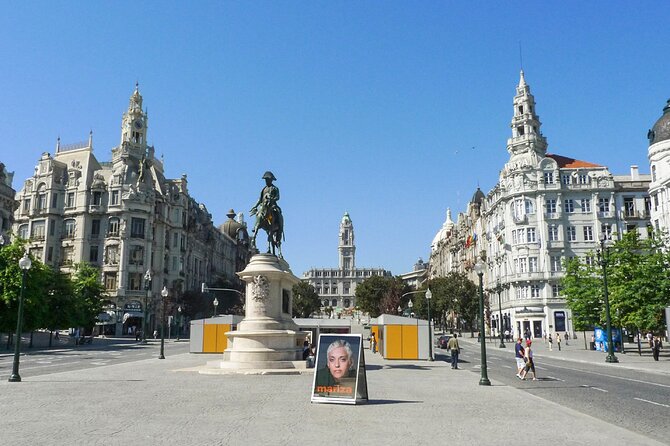
The route continues toward the Soares dos Reis National Museum, Portugal’s oldest public museum. It occupies the Palácio dos Carrancas, an 18th-century building, and contains fine art, decorative art, and archaeology.
This is a useful sight for museum fans, but it is not presented as a full museum visit. You should not expect to see its collection in a few minutes. Instead, consider it an exterior landmark unless you arrange extra time.
The Palácio de Cristal Gardens offer a change of pace. These 19th-century Romantic gardens cover eight hectares and include the Émille David Garden, an avenue of lime trees, woodland, and balconies overlooking the Douro. The gardens preserve much of the original design.
This is one of the places where a private tour can be adjusted to suit your interests. A short stop gives you a viewpoint and a breath of fresh air. A longer stop would be better if you want to walk the paths, but that means sacrificing time elsewhere.
The Electric Car Museum occupies the former Massarelos power station. Its collection includes trams, support vehicles, and an example of an American horse-drawn trolley vehicle introduced to Porto in 1872. The former power station also preserves some original equipment.
Nearby, the Museum of Transport and Communications occupies a neoclassical 19th-century building with facades facing both the Douro and the city. Its iron construction used stone, brick, and wood in different sections. Both museums are appealing to visitors who want more than churches and viewpoints, but neither can be properly explored during a quick panoramic tour.
The Church of São Francisco is one of the major paid sights. Construction began in the 14th century, and the Gothic structure later received lavish Baroque wood carving. Its golden interior is so lavish that it earned the nickname Gold Church. Look for the Tree of Jesse and consider visiting the catacombs.
Admission is listed at €10 per person. This is one of the paid entries I would prioritize if you appreciate interiors. The exterior alone gives only a fraction of the experience.
The nearby Church of São Nicolau reflects Porto’s late 17th-century religious architecture. Its style is mainly Mannerist with some Baroque influence, and the nave contains an altarpiece dedicated to Saint Nicholas, patron of metalworkers.
Palácio da Bolsa, the city’s former commercial palace, is another important paid visit. Built in neoclassical style in 1842 on the site of the former São Francisco Convent, it now houses the Porto Commercial Association. Its Arab Room is the main draw, and guided entry costs €14 per person.
Since both Palácio da Bolsa and São Francisco require separate admission, this is an area where costs can rise quickly. Choose one or two interiors rather than trying to enter every monument during a four-hour outing.
The Douro bridges and Gaia viewpoints
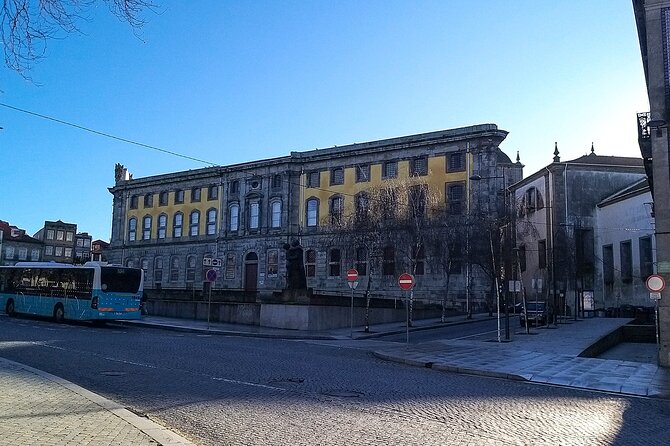
The tour gives you a compact lesson in bridge design. The old suspension bridge, inaugurated in 1843 as D. Maria II, lasted only four years because of safety concerns. Two stone obelisks are all that remain.
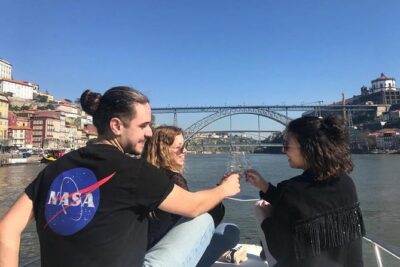
The D. Luís I Bridge, completed in stages between 1886 and 1888, is the great landmark of the Douro crossing. Designed by Teófilo Seyrig, who had worked with Gustave Eiffel, its large wrought-iron arch was a major engineering achievement. The bridge forms part of Porto’s UNESCO-listed historic center.
You also see the newer Infante Bridge, opened in 2003. Its 371-meter deck replaced the upper level of D. Luís I Bridge for one of Porto’s Metro lines. The bridge uses a slender Maillart-type arch.
D. Maria Pia Bridge, designed by Gustave Eiffel and Théophile Seyrig, opened in 1877 and carried trains for 114 years. Its single-track rail deck rests on lattice supports above a bi-articulated arch. The São João Bridge, designed by Edgar Cardoso and opened in 1991, now carries the rail route south from Campanhã.
At Jardim do Morro in Vila Nova de Gaia, you get one of the best open views toward Porto, the river, and the bridges. The park offers broad paths and green space beside the Monastery of Serra do Pilar.
The monastery began in 1538 for the Order of Saint Augustine and took centuries to complete. Its circular church and circular cloister make it unusual in European classical architecture. Admission is not included, and the stop lasts about 10 minutes.
This part of the route is especially useful for first-time visitors. You see Porto from both banks and understand how the river shapes the two cities. If you want photographs, tell the guide. The short timing makes it easy to move on before you have found the best angle.
From Foz and Matosinhos to modern Porto
The tour then heads west, passing the Arrábida Bridge and the coast. Opened in 1963, the Arrábida Bridge was once the world’s longest reinforced-concrete bridge. Bronze sculptures sit above its four main pillars.
Fort São João Baptista, built at the end of the 16th century, protected the Douro entrance and the coast. Later additions include 17th-century defensive works and an 18th-century gate. Admission is not included, and the stop is scheduled for 15 minutes.
Castelo do Queijo, officially Fort São Francisco Xavier, was built in the 17th century to protect the coast from North African pirates. Its position on a rounded rocky outcrop gave it the popular name Cheese Castle. The visit is listed as free and lasts about 15 minutes.
The coastal portion also includes the statue of King João VI, the large Anemone sculpture by Janet Echelman, Leixões Cruise Terminal, and the Serralves Foundation. The Anemone resembles a huge fishing net moving in the wind, a fitting piece for this sea-facing part of Porto.
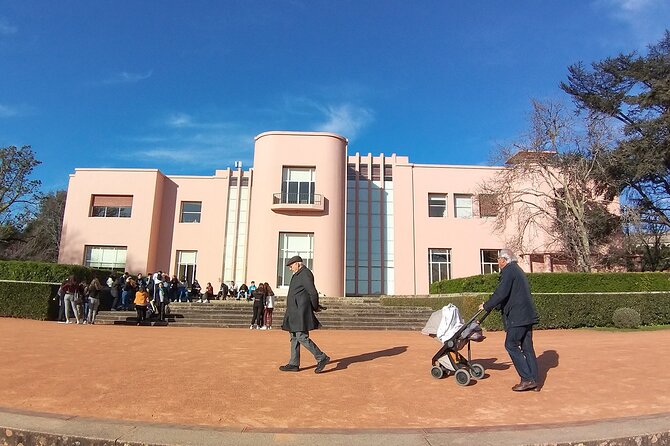
Serralves combines a 1930s Art Deco house, an 18-hectare park, a contemporary art museum, a traditional farm, and woodland. The route does not provide time for a full visit, but the exterior and grounds give you a taste of Porto’s modern cultural side.
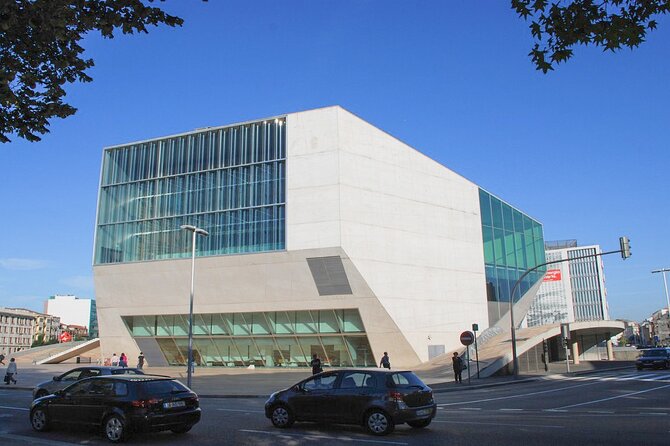
Casa da Música, designed by Rem Koolhaas and opened in 2005, is another modern landmark. Its unusual form contrasts sharply with Porto’s churches and tiled facades. At Praça de Mouzinho de Albuquerque, a 45-meter monument honors the Portuguese and English alliance against Napoleon’s forces during the Peninsular War.
What the $185.43 price really buys
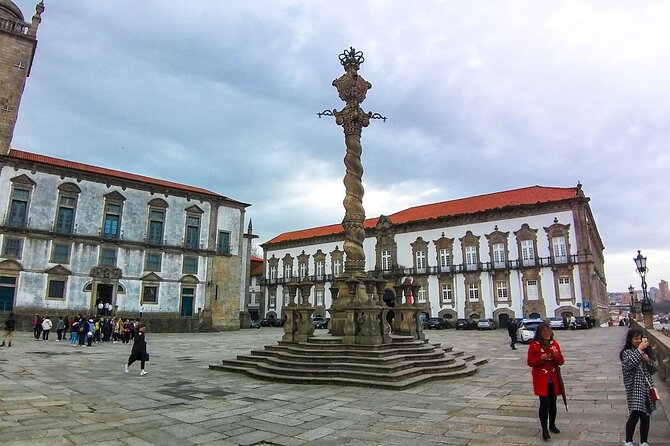
The advertised price is $185.43 per person. For a private four-hour outing, that buys more than transport. You receive hotel pickup, a private group experience, a luxury vehicle, Wi-Fi, bottled water, refreshments, and insurance.
The value is strongest for a small group that wants to cover distant sights without arranging several taxis or public transport connections. A private vehicle also lets you see central Porto, Gaia, the riverfront, Foz, Matosinhos, and Boavista in one afternoon.
The price is less attractive if you mainly want to walk Porto’s old center. Many central sights sit close together, and paid entries are not included. Add Livraria Lello at €16, Clérigos at €10, Palácio da Bolsa at €14, and São Francisco at €10, and the total rises by €50 per person before any optional evening activity.
The optional extras are substantial. A private two-hour Douro sunset cruise costs €360 to €460 in total. The Dona Antónia Port wine cellar visit and tasting costs €32 to €41 per person, while dinner with fado and transport ranges from €65 to €80. A one-hour fado show with Port wine costs about €20 to €26.
I would book the basic tour for orientation, then choose only one add-on. The Port tasting fits naturally with a visit to Gaia. The sunset cruise offers the most special setting, but it costs the most. Fado makes more sense as an evening plan after the sightseeing ends.
Who should book this Porto tour?
I would choose this experience if you have only one afternoon, prefer private transport, or want a guide to connect Porto’s many landmarks. It suits couples, families, and small groups who value comfort and a flexible route.
It also works well if you are arriving by cruise ship or staying outside the historic center, since hotel pickup is offered and Leixões is included among the coastal sights. The vehicle has Wi-Fi, water, and refreshments, practical touches during a packed route.
I would hesitate if your priority is museum time, long church visits, market browsing, or climbing Clérigos Tower without watching the clock. The advertised four hours cover a lot of ground, but the schedule gives most major stops only 10 to 15 minutes.
The experience has a 4.9 rating from 11 published ratings, and 100 percent of the listed participants recommend it. One especially positive comment praised the guide’s command of the area, its history, and the high quality of the journey. The guide’s name is not provided, so you cannot request a particular guide from the available details.
Free cancellation is available up to 24 hours before the start time. Poor weather or failure to meet the minimum group size can lead to a new date or a full refund. Most people can participate, and service animals are allowed.
Should you book it?
Book it if you want a comfortable first look at nearly every side of Porto and accept that the tour moves quickly. The private format, hotel pickup, and route from Bolhão to the Atlantic make this a useful orientation day.
Skip it if you want to linger. In that case, spend the afternoon on foot around São Bento, Clérigos, Carmo, São Francisco, and the Ribeira, paying for only the interiors that matter most to you. For everyone else, this tour works best as a broad introduction, followed by a return visit to your favorite places.
FAQ
How long does the Porto private afternoon tour last?
The tour lasts approximately four hours and ends back at the meeting point.
Is hotel pickup available?
Yes. Hotel pickup is offered, and you provide your hotel details when booking. The stated meeting point is Avenida dos Aliados in Porto.
Is this a private tour?
Yes. Only your group participates in the activity.
Are attraction admission fees included?
No. Entry fees are separate. Listed examples include €16 for the Gold Ticket at Livraria Lello, €10 for Clérigos Tower, €14 for Palácio da Bolsa, and €10 for São Francisco Church.
Is transportation included?
Yes. Transportation is provided in a luxury executive vehicle with Wi-Fi, bottled water, refreshments, and a comfortable interior. Personal accident and civil liability insurance are also included.
Can I add a Douro cruise, Port tasting, or fado?
Yes. Optional activities include a private two-hour sunset Douro cruise, the Dona Antónia Port wine cellar visit and tasting, dinner with fado, and a one-hour fado show with Port wine. These activities cost extra.
Latest reviews around Porto
- Private Walking Tour, highlights and secrets of Porto★ 3.9 · 3 reviews
- Private Porto Half-Day Tour – Wine Cellars & Cheese Tasting★ 5.0 · 3 reviews
- Portuguese Wine Tasting w Local Cheese & Cold Cuts pairing★ 5.0 · 3 reviews
- From Peso da Régua: Visit 3 wineries, tasting and viewpoint★ 5.0 · 3 reviews
- Porto: Full-Day All-Inclusive Private City Sightseeing Tour★ 4.3 · 3 reviews
- Small Painting Group with a Local Artist in Porto★ 5.0 · 3 reviews
- From Arouca: Paiva River Rafting Adventure – Adventure Tour★ 5.0 · 3 reviews
- Private Tour to Santiago de Compostela and its stunning Cathedral★ 5.0 · 3 reviews
Private, compared.
Discover Porto’s Highlights on a 2-Hour Private Electric Tuk Tuk
Read our review →
Porto PRIVATE TOUR With Locals: Highlights & Hidden Gems
Read our review →
Porto: Private tour in the Douro (1 to 4 people) on a boat just for you
Read our review →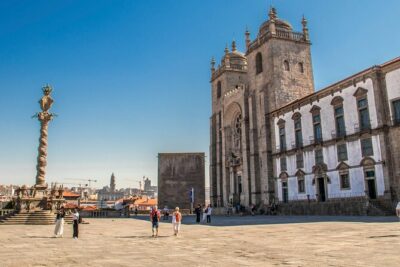
Historic Porto by Private Electric Tuk Tuk to Top Landmarks
Read our review →
Porto:Private Tour of the Historic City in a Classic Ford T
Read our review →
Porto Private Food and Drink Tasting Tour with Local
Read our review →