
Reviewed · PORTO
Rappelling and Climbing Adventure in Lamas de Mouro
The most unusual part of this Lamas de Mouro adventure is its mix of challenges: you climb trees, slide through the canopy, scale a 9-meter wall, then rappel with your back toward a dark drop. It turns a quiet corner of northern Portugal into a compact test of nerve and strength.
I like the small maximum group of 10, since guides can give more help when someone freezes halfway up. I also like the patient instruction reported from guides such as Filipe, Helder, Francisco, Duarte, João, and Jéssica. The main drawback is simple: two hours passes quickly, and transport, water, and snacks are not included.
In This Review
- Key points at a glance
- A compact adventure in Lamas de Mouro
- Starting at Porta de Lamas de Mouro
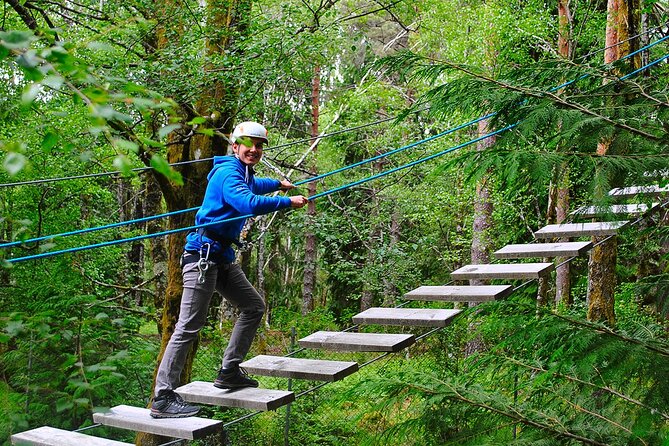
- Tree climbing to get used to the height
- The canopy slide brings the fun
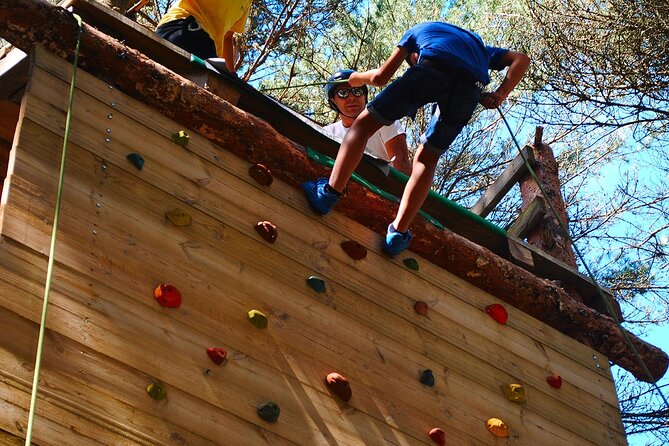
- The 9-meter wall tests strength
- Rappelling into dark caverns
- Equipment and photo reportage
- How the guides shape the experience
- Who should book this activity
- Weather, timing, and cancellation
- Is the Lamas de Mouro adventure worth booking?
- FAQ
- Where does the activity start?
- Where does the activity finish?
- How long does the adventure last?
- What language is offered?
- What equipment is included?
- Do I need to bring food or water?
- What happens if the weather is poor?
Key points at a glance
- A four-part challenge: Tree climbing, a canopy slide, a 9-meter climbing wall, and rappelling into dark caverns.
- Good beginner support: Guides explain each task carefully and have helped people through fear and panic.
- Small group size: The activity accepts a maximum of 10 people.
- Practical value: At $30.79 per person, the price covers equipment and photo reportage, making it a fairly accessible outdoor activity.
- Moderate fitness needed: You will need enough strength and balance to climb, hold on, and control your movements.
- Weather matters: Poor conditions can lead to a new date or a full refund.
A compact adventure in Lamas de Mouro
Lamas de Mouro is in northern Portugal, close to the mountain setting of the Montes de Laboreiro area. This is not a sightseeing tour with a long route or a list of monuments. You come here to move, climb, trust your equipment, and spend two hours outside the usual travel routine.
The course is built around a clear progression. You start with climbing among trees, then move through the canopy on a slide. After that comes a 9-meter wall, followed by rappelling down into dark caverns. Each section asks for something different, so the activity does not depend on one kind of athletic ability.
I like this format for a first adventure activity. You can discover how you react to height without committing to a full-day canyoning trip. The short duration also makes it easier to fit into a northern Portugal road trip.
Still, two hours is an estimate, not a promise that every moment will be action. With a group of up to 10, some waiting can happen while people take their turn. A family experience reported waiting between turns, though the children still enjoyed the activity.
Often booked together with this one in Northern Portugal:
- Star canyoning
★ 5.0 · 290 reviews - Private Rafting Experience in Melgaço
★ 5.0 · 186 reviews - Classic Wine Tasting with GUIDED TOUR
★ 5.0 · 93 reviews
Starting at Porta de Lamas de Mouro
You meet at Porta de Lamas de Mouro, at the listed address on an unnamed road in Lamas de Mouro. The activity finishes at the same meeting point, which keeps the day straightforward if you are driving or have already arranged a lift.
Private transport is not included. That detail matters more here than it would on a city tour. You need to plan your route to the meeting point before booking, especially if Lamas de Mouro is only one stop on a larger northern Portugal itinerary.
The mobile ticket is useful for a simple arrival process. Confirmation is provided when you book, and the activity is offered in English. The published information does not give a detailed packing list, so I would arrive ready for physical activity and bring your own bottled water and snacks.
The meeting point is also where you return at the end. You do not need to arrange a separate pickup from the final rappel or climbing section.
Tree climbing to get used to the height
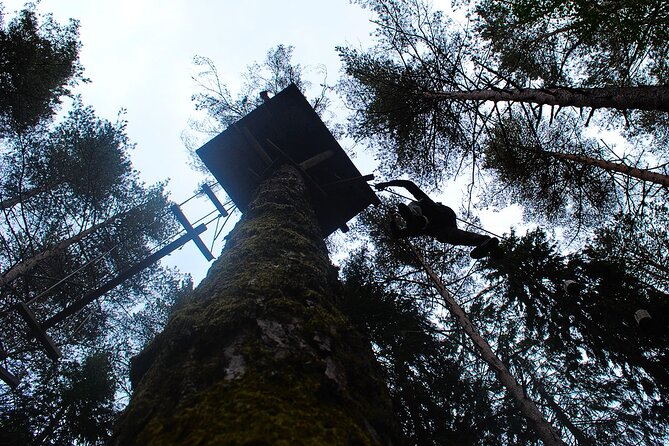
The first major activity is tree climbing. The purpose is not only to get higher. It gives you time to understand the harness, strings, carabiners, and lifeline connector before the more exposed sections begin.
For someone uneasy with heights, this can be the most useful part of the course. You have the trees around you, a structured task in front of you, and a guide nearby to explain what to do. The physical action gives your mind something to focus on besides the drop.
The guides receive especially strong praise for helping beginners. Filipe, Helder, and other instructors are described as calm and attentive, while Duarte, João, and Felipe are credited with handling moments of panic well. That is important because fear does not always arrive at the top. A person can feel confident on the ground and still need careful help once the height becomes real.
You should not treat the tree climb as a gentle warm-up with no effort. Even with safety equipment, you will need to grip, step, balance, and follow instructions. The stated fitness requirement is moderate, so this is better suited to someone comfortable with basic physical exertion than to someone seeking a passive nature outing.
The canopy slide brings the fun
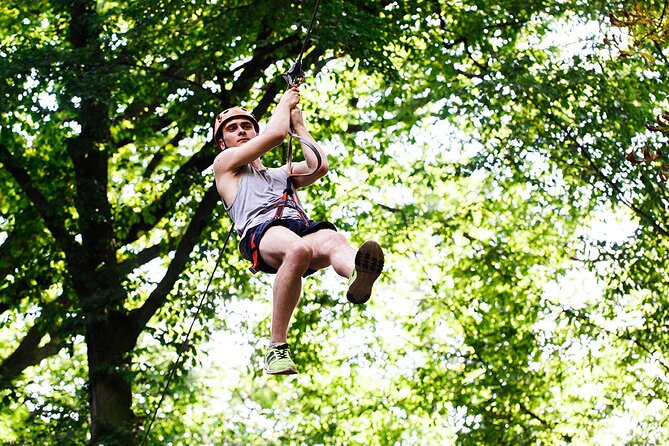
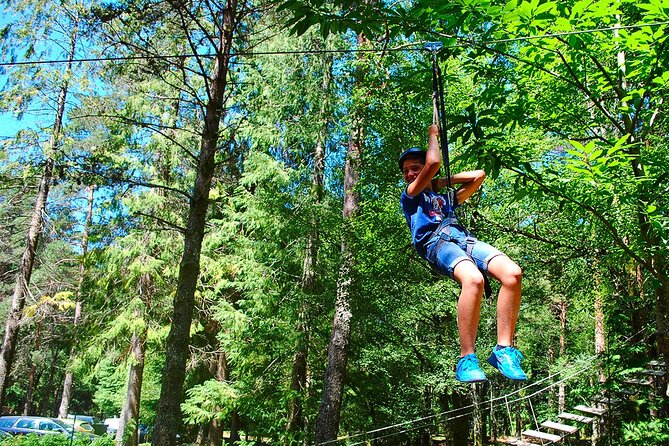
After climbing, the course sends you through the trees on a slide. This is likely the most immediately playful section, since it replaces slow climbing with a quick ride through the canopy.
I like having this release after the first height challenge. Tree climbing asks you to make deliberate movements. The slide lets you stop overthinking and enjoy the feeling of moving through the trees.
The slide also helps balance the course. Not every part is about strength or courage. You get a clear reward for making it through the climbing section, then return to a more technical challenge at the wall and rappel.
The information provided does not give the slide length, speed, or exact landing setup. Do not book it expecting a particular scale of zip line. Think of it as one part of a short multi-activity course, not a standalone high-speed ride.
For families, the age and height rules need careful checking before booking. One family reported that 7-year-old children joined the activity, while children without the minimum height for the tree section could not take part in that particular element. The exact minimum height is not provided, so contact the provider before paying if your children are small.
A different sort of Northern Portugal day altogether:
- Rafting Experience on the Minho River with Coraltours Minho
★ 5.0 · 70 reviews - PREMIUM TASTING and TAPAS with GUIDED TOUR
★ 5.0 · 66 reviews - Dirt and Dust Tour by Oporto Buggy
★ 4.5 · 63 reviews - 30 minutes Buggy Ride
★ 5.0 · 49 reviews
The 9-meter wall tests strength
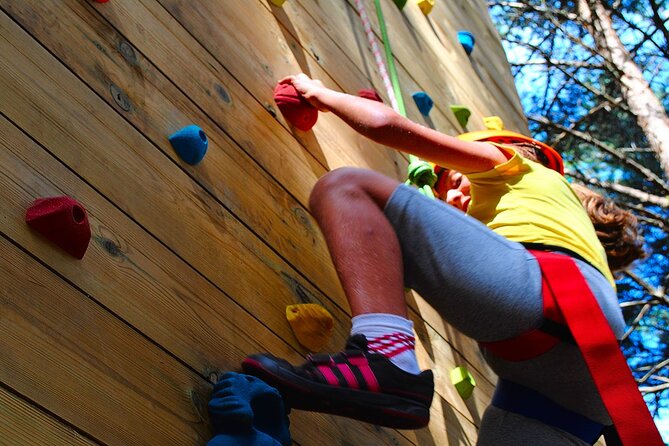
The climbing wall is 9 meters high, giving the activity a more direct physical test. Unlike the tree section, where you move through a natural setting, the wall makes your progress easy to measure: you climb, pause, search for the next hold, and work out how to continue.
This is where upper-body strength, leg power, and patience matter. You do not need to race. A steady pace is more useful than trying to prove something in the first few seconds.
I would pay attention to how your hands and arms feel by this point. The course combines several activities, so tired muscles can make the wall feel harder than its height suggests. Listen to the guide and use your legs rather than pulling only with your arms.
The wall is also a useful confidence marker. If heights bother you, reaching the top after the tree climb can change how you see the final rappel. If the wall leaves you tired or tense, tell the guides before moving on. The strongest part of this experience is not the equipment alone. It is the human support when a participant needs to slow down.
Rappelling into dark caverns
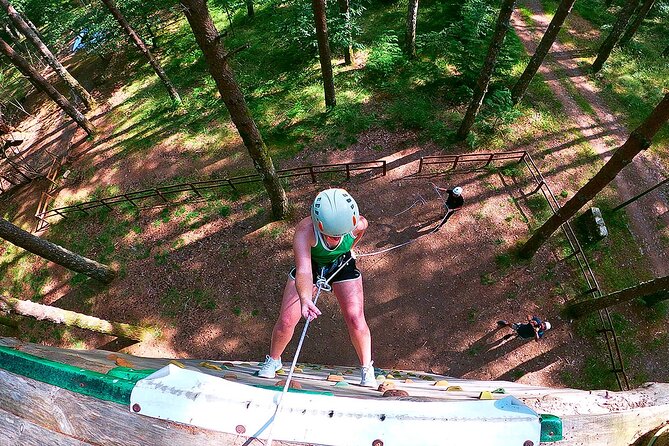
The rappel is the most dramatic part of the course. You move backward toward an abyss and descend into dark caverns, relying on the harness and rope system while the guide manages the safety instructions.
For many people, walking backward toward an edge feels wrong even when they understand the equipment. That is the point of the challenge. The activity asks you to trust the system, keep listening, and control your nerves one movement at a time.
The dark cavern setting gives the rappel a stronger sense of adventure than a simple descent down an open wall. You are not only looking down at the ground. You are moving into a shadowy space, which can make the final section feel more memorable.
Some outings connected with this provider have included three rappels, jumps, and a rappel inside a waterfall. The activity details here specifically promise rappelling into dark caverns, not a waterfall route, so you should not assume those extra features are part of every booking.
The staff’s handling of fear is one of the clearest reasons to choose this course. Several participants needed reassurance, including a child and an adult who experienced a panic attack. The guides were described as staying present and helping people continue safely. That does not remove the challenge, but it means you are not expected to manage it alone.
Equipment and photo reportage
The price includes a harness, strings, carabiners, and a lifeline connector. These are the basic pieces that allow you to climb and rappel under the activity’s safety system.
The equipment list is short, but it covers the core gear supplied for the course. Since clothing and personal items are not listed, arrive prepared for an outdoor activity rather than assuming every comfort item will be provided.
Photo reportage is also included. That adds value if you want a record of the climb, slide, wall, and rappel without asking a companion to remain on the ground with a phone. The details do not explain how many photos you receive or how they are delivered, so consider this a welcome extra rather than the main reason to book.
Snacks, bottled water, and private transport are not included. At $30.79 per person, the price remains modest for a guided activity with safety equipment and photos, but the final cost of your outing will be higher if you need to pay for transport or food separately.
How the guides shape the experience
The strongest pattern in the feedback is the quality of instruction and personal attention. Filipe and Francisco are praised for supporting beginners. Helder is noted for staying close to a first-time participant who needed help. Other named guides include Duarte, João, Jéssica, Horácio, and Cissé.
That range of names suggests a team-based operation rather than one fixed guide, so you may not receive a particular instructor on your date. Still, the repeated emphasis on patience, clear explanations, and calm responses to fear is useful information when you are comparing adventure activities.
I would choose this course over a less structured attraction if someone in your group is nervous about heights. You cannot guarantee that fear will disappear, but the guides appear used to helping people manage it rather than making fun of it or rushing them.
A small group helps here. With no more than 10 people, the staff has a reasonable chance to see when someone needs extra instruction. It also means the course may feel less private than a one-to-one session, and waiting can occur while other people complete a section.
Who should book this activity
This is a good match for first-time climbers, families with children who meet the provider’s requirements, couples looking for a physical outing, and anyone who wants a short break from city sightseeing.
It suits you especially well if you enjoy a challenge but do not want a full-day canyoning program. You get several types of activity in one visit, including a fun slide and more serious height work.
You should think twice if you dislike heights, have limited physical fitness, or want a quiet nature walk. The staff can help with nerves, but the course still involves climbing and rappelling. Support is not a substitute for being ready to take part.
Children may be able to join, but the available information does not provide a full age or height chart. The report of 7-year-olds taking part is encouraging, but check the current requirements for your own children before booking.
Weather, timing, and cancellation
The activity depends on good weather. If poor conditions force a cancellation, you can receive a different date or a full refund. The same options apply if the minimum number of participants is not reached.
You can cancel for a full refund up to 24 hours before the start time. Changes or cancellations made less than 24 hours in advance are not accepted for a refund, and the cut-off uses local time.
The two-hour duration is useful for planning, but allow extra time around the start if your day is tightly scheduled. The course may include pauses while people take their turns, and the actual pace can depend on group confidence and weather.
Is the Lamas de Mouro adventure worth booking?
At $30.79, I think this is a strong-value choice if you want a short, guided outdoor challenge in northern Portugal. The price includes the safety gear and photo reportage, and the course gives you four distinct activities rather than one climb repeated several times.
Book it if you want patient help with heights, enjoy trying several challenges in one session, and can reach Porta de Lamas de Mouro on your own. The most important reason to choose it is the careful guide support, especially for beginners and people who may panic.
Skip it if you need transport, refreshments, or a relaxed sightseeing activity included in the price. Also check height requirements for children and remember that the published two-hour format may include some waiting.
For the right person, this is a lively, affordable way to turn a stop in Lamas de Mouro into a real physical memory. You climb, slide, test the wall, and finish by trusting a rope above a dark cavern.
FAQ
Where does the activity start?
It starts at Porta de Lamas de Mouro, on the listed unnamed road in Lamas de Mouro, Portugal.
Where does the activity finish?
The activity ends back at the meeting point.
How long does the adventure last?
The activity lasts approximately two hours.
What language is offered?
The experience is offered in English.
What equipment is included?
A harness, strings, carabiners, and a lifeline connector are included. Photo reportage is also included.
Do I need to bring food or water?
Yes. Snacks and bottled water are not included, so you need to arrange them yourself.
What happens if the weather is poor?
If the activity is canceled because of poor weather, you will be offered another date or a full refund.
Latest reviews around Northern Portugal
- Waterfall Route in Peneda Gêres National Park★ 5.0 · 3 reviews
- Deep canyoning★ 5.0 · 4 reviews
- Buggy or Moto4 tour through Melgaço★ 5.0 · 5 reviews
- Moliceiro boat trip, with experience in bivalves harvesting★ 5.0 · 5 reviews
- Private visit with wine tasting in Alijó Douro★ 5.0 · 5 reviews
- Private Guided Tour – Peneda Gerês National Park★ 5.0 · 8 reviews
- 4×4 Adventure in Douro: Wine Tasting, Boat Trip and Lunch★ 5.0 · 9 reviews
- Canyoning on the River Varziela – Initiation Route★ 5.0 · 9 reviews