
Reviewed · PORT WINE CELLAR TOURS
Porto: Tile Painting Workshop with Tea and Port Wine
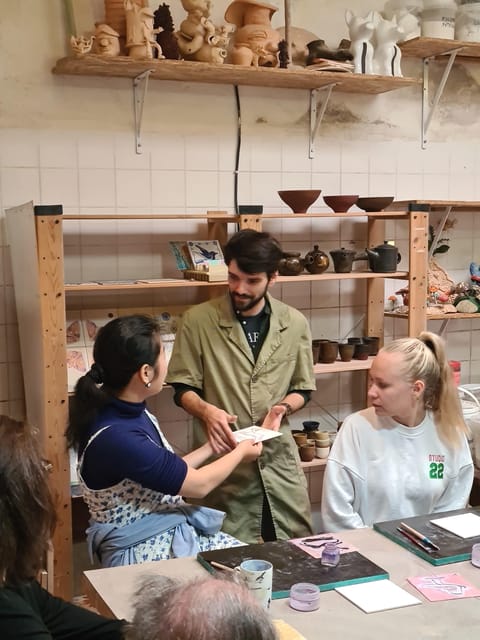
Porto’s famous tiles are more than pretty blue decoration. They cover churches, railway halls, houses, and city landmarks, and this two-hour workshop lets you move from admiring them to making your own. You’ll hear how the craft developed, study traditional designs, and paint two tiles to collect after kiln firing.
I like the fact that you receive two tiles per person, not just one, and that the finished pieces are fired and packaged for pickup the following day. I also like the friendly, hands-on teaching: David has been praised for his clear guidance, while stencils and sample designs help children and less confident artists get started.
The main consideration is timing. You must return around 11:00 or 12:30 the next day to collect the tiles, so this works best if Porto is not your final stop that morning. The introduction can also feel a little long if you are eager to start painting.
In This Review
- Key points at a glance
- Why painting tiles adds something to a Porto visit
- Arriving near Campanhã Station
- The opening lesson: tiles, Porto, and Portuguese design
- Learning the tile-painting techniques
- Painting two tiles with room for your own ideas
- What happens after the brushes are put away
- The guide and the feel of the studio
- Is $53 a fair price?
- Who will enjoy this most
- Booking details worth knowing
- Should you book the Porto tile workshop?
- FAQ
- How long does the tile-painting workshop last?
- How many tiles does each person paint?
- Can I take the tiles home immediately after painting?
- Is packaging for the tiles included?
- Which languages are available?
- Where does the workshop meet?
- Is transportation included?
Key points at a glance
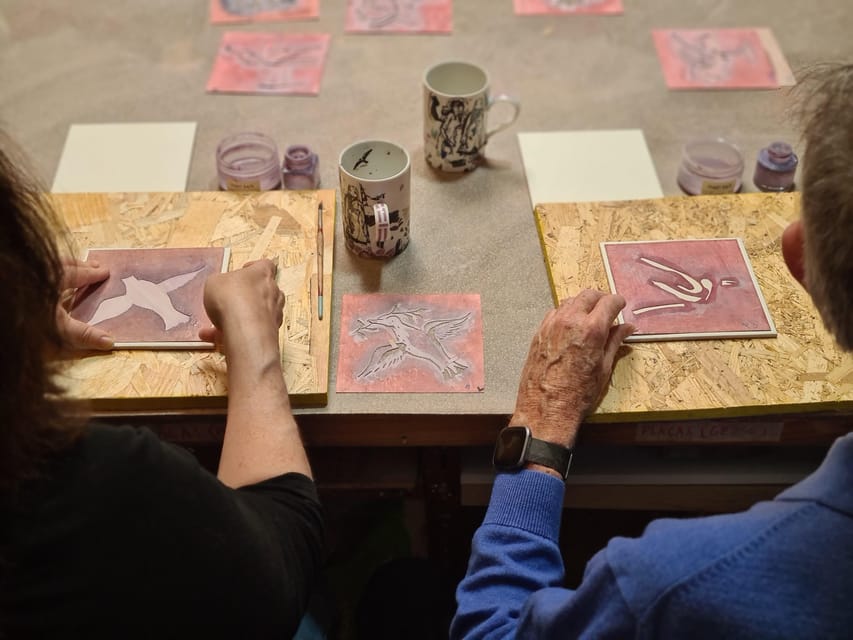
- Two handmade souvenirs: Paint two Porto-inspired tiles, then collect the kiln-fired pieces the next day.
- A practical look at Portuguese ceramics: Learn how tiles are made and why they appear across homes, monuments, and heritage buildings.
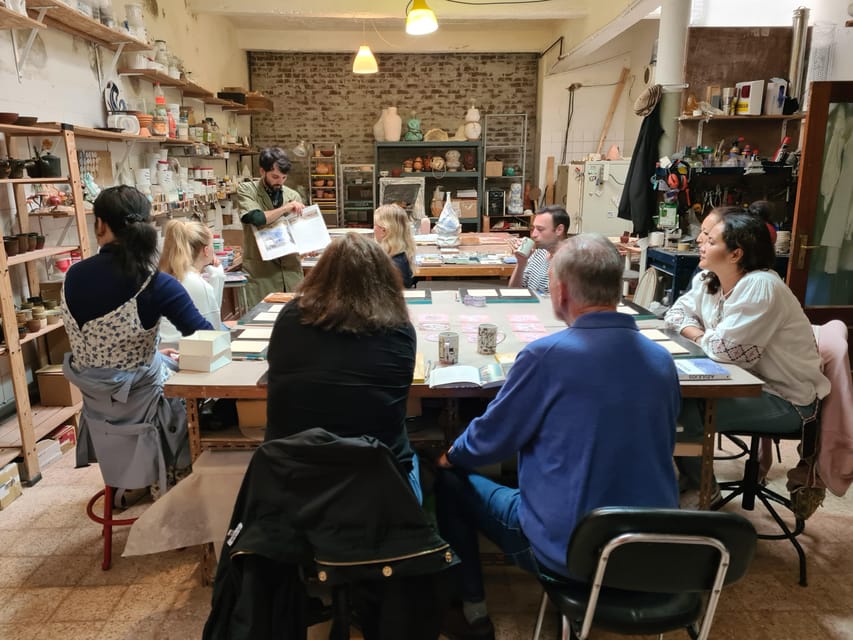
- A welcoming small-group setting: The studio offers personal help, with English, French, and Japanese instruction available.
- Tea and biscuits included: The session begins with a relaxed introduction and a simple refreshment.
- Useful Campanhã location: The workshop is near Porto’s train station and TIC bus terminal, though parking is limited.
- Good for families: An eight-year-old, teenager, and adults can all take part, with stencils and advice available when needed.
Why painting tiles adds something to a Porto visit
You can see Portuguese tiles all over Porto without spending a cent. São Bento Station is famous for its large blue-and-white panels, and many churches and old buildings use patterned tiles as both decoration and protection from the weather. It is easy to admire the color, but harder to understand how these small ceramic pieces are designed and produced.
This workshop gives you that missing piece. You are not simply shown a finished object in a shop. You learn about the role of tiles in Portuguese art and culture, then work with the materials yourself. That change in viewpoint matters. Afterward, you are more likely to notice repeated motifs, borders, symmetry, and the way tiled surfaces shape Porto’s streets.
The activity also gives you a souvenir with a clear connection to your time in the city. A mass-produced tile may be attractive, but two pieces painted by you carry a different sort of value. They may not be perfect, and that is part of the charm. They record where you were and what you tried.
More port wine cellars to visit:
- Porto: Live Fado Show with Glass of Port Wine
★ 4.8 · 6,498 reviews - Porto: Cálem Cellar Tour, Interactive Museum & Wine Tasting
★ 4.5 · 4,113 reviews - Porto: Cálem Cellar Tour, Fado Show & Wine Tasting
★ 4.4 · 3,530 reviews
Arriving near Campanhã Station
The workshop is near Campanhã train station and the new TIC, or Terminal Intermodal de Campanhã. You will find a school and a taxi rank beside the station, which are useful landmarks when you are finding the store.
This is a practical location if you are arriving or leaving Porto by train or bus. It is less convenient if you expect to drive. One participant specifically found the area unfriendly for parking, so I would avoid building your plan around finding a space nearby. Public transport or a taxi is the safer choice, based on the location details provided.
Allow yourself enough time to find the store. The meeting point is described by nearby landmarks rather than by a major tourist sight, so arriving a little early is sensible. Comfortable shoes and comfortable clothes are recommended. You are sitting and working for much of the class, but you still want clothing that lets you relax and focus.
The opening lesson: tiles, Porto, and Portuguese design
The session begins with an introduction to Portuguese tiles. You learn where tiles appear in Portugal and why they matter in Porto, from decorated homes to monuments and heritage buildings.
The workshop also uses examples, inspiration books, and different types of tiles and sculptures to show how ceramic decoration is used. This helps you see that Portuguese tile work is not limited to one blue-and-white style. Traditional motifs can give you a starting point, while the samples help you understand the range of shapes, colors, and decorative ideas.
Tea and biscuits are served during this early part of the session. One class included a self-planted herbal infusion, which gives the beginning a homely studio feel rather than the brisk pace of a formal lesson.
There is a small tradeoff here. The historical introduction is useful, especially if you know little about Portuguese ceramics, but some people will want to paint sooner. A family with children may find this section longer than necessary. If you are especially keen to start creating, expect some listening time before the brushes come out.
Learning the tile-painting techniques
Next, the instructor explains the basic techniques used in traditional Portuguese tile production. The exact level of detail can depend on the group and the questions asked, but the purpose is clear: you are shown how to approach the surface before making your own choices.
This is where the experience becomes more than a craft table. You learn that a tile is not simply a blank square waiting for any picture. Traditional motifs, repeated patterns, and careful placement all matter. Even a simple design can look more connected to Porto when it uses the shapes and ideas introduced in the class.
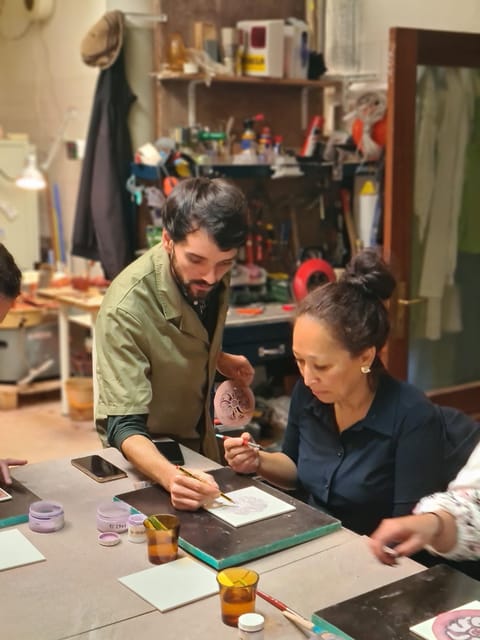
Stencils are available, which is helpful if you are working with children or do not feel confident drawing freehand. They provide structure without forcing everyone to make identical tiles. The instructor and assistant can answer questions, offer creative advice, and explain what to expect from the process.
The teaching style appears to leave room for personal choice. You are guided, but the studio does not simply complete the design for you. That balance is important. You get support when needed while still making the central decisions yourself.
More azulejo tile workshops:
- Porto: Tile Painting and Cocktails in Downtown Porto
★ 4.9 · 484 reviews - Tile Painting and Cocktails in Downtown Porto
★ 5.0 · 187 reviews - Porto: Tile Painting Workshop with Porto Wine (Sé do Porto)
★ 5.0 · 102 reviews - Porto Tile Painting Workshop in artist studio
★ 5.0 · 83 reviews
Painting two tiles with room for your own ideas
Each participant paints two tiles inspired by traditional motifs. This is the heart of the activity, and it is also the part that requires the most patience.
You may begin with a stencil, copy an idea from the inspiration material, or create a design of your own. The studio provides the materials and instructions, and the staff remain available as you work. The goal is not to produce museum-quality ceramics in two hours. The goal is to learn the process and make something personal.
Two tiles make a real difference. With one tile, you have only one chance to settle into the technique. With two, you can try a safer design first and then take more risks with the second. You can also create a pair, using related colors or a repeated pattern.
Families should find this format particularly useful. The activity has worked for groups including adults, a teenager, and an eight-year-old. Younger participants can use the stencils and ask for help, while older children and adults can develop more detailed designs. Artistic skill is not a requirement, although people who already enjoy drawing may want more time to refine their work.
Time is the one limit to keep in mind. A family group noted that they would have preferred less tea and introductory material and more painting time. If you work slowly, keep your design fairly simple. A bold pattern that is finished properly will usually make a better keepsake than an ambitious picture left incomplete.
What happens after the brushes are put away
You do not take the wet tiles home immediately. The pieces must be fired in a kiln, and they are ready about 24 hours after the class.
You then return the next morning, around 11:00 or 12:30, to collect them. They are packaged properly for the journey home. This extra step improves the souvenir considerably. The firing turns your painted surface into a finished ceramic object, and the packaging reduces the worry of carrying fragile pieces through the rest of your trip.
The pickup requirement also shapes your schedule. I would book this workshop early in your Porto stay, not on the final afternoon before departure. If you are taking a morning train or bus the next day, you may not have enough time to return. Check the collection time when you book and keep the following morning open.
You also need to accept that the final result may not look exactly as it did during painting. Firing is part of ceramic work, and the finished colors and surface are the result of that process. That uncertainty is a normal part of making a real object rather than buying a perfect factory souvenir.
The guide and the feel of the studio
The listed provider is Francisco Pessegueiro, and David has been praised for his personal teaching and ability to answer questions. The supplied information does not promise that David leads every session, so check the booking details if having a particular instructor matters to you.
The available languages are English, French, and Japanese. If you need the session in French or Japanese, you must state that when booking. This is worth doing in advance rather than assuming the language will be arranged at the door.
The studio is described as warm, welcoming, and safe for creative work. That matters because tile painting can feel intimidating at first. You are working with other people, and it is reassuring to have an instructor nearby who can give advice without taking over.
Small groups are available. The exact size is not stated, so do not assume every departure will be private or tiny. Still, the format is designed for instruction and questions rather than a large demonstration where you are left on your own.
Is $53 a fair price?
At $53 per person, the value depends on what you want from a Porto activity. You are paying for two hours of instruction, all painting materials, tea and biscuits, kiln firing, and packaging. Most importantly, you get two finished tiles rather than only a brief demonstration.
The price makes more sense if you see this as both a cultural lesson and a creative activity. You are learning about a major part of Portuguese visual culture, then producing a pair of souvenirs. The firing and next-day pickup add work for the studio that would not be included in a simple drop-in craft session.
It is less appealing if you only want a quick, inexpensive souvenir or if you dislike scheduled activities. The class includes an introduction, instruction, painting time, and a separate pickup. You need to give it part of two days, even though the actual class lasts only two hours.
Compared with a standard sightseeing stop, the workshop offers a different kind of value. You leave with more than photographs and facts. Compared with buying a tile in a shop, it costs more and takes more time, but the finished pieces have your own design on them.
Who will enjoy this most
I would recommend the workshop to you if you like making things, want a hands-on break from sightseeing, or are curious about the tiles you see around Porto. It is especially suitable for families because two tiles per person give children enough material to experiment.
It also suits couples and friends who want a shared activity without committing to a full-day tour. You can work independently while still comparing ideas and designs. People who enjoy art, design, architecture, or local crafts will get the most from the opening lesson.
You may want to skip it if your Porto schedule is too short to return the next day. It may also frustrate you if you want a long, quiet period for highly detailed painting. The class combines cultural explanation and making, so it is not a pure studio session.
The language choice is another practical factor. English is available, along with French and Japanese. State your preferred French or Japanese language when booking.
Booking details worth knowing
The experience lasts two hours, with starting times that vary by availability. Transportation to and from the workshop is not included, so you arrange your own way to the Campanhã area.
Tea and biscuits are included, but other food and drinks are not. Comfortable clothing and shoes are sensible, especially if you plan to continue exploring Porto after the class.
You can cancel up to 24 hours in advance for a full refund, and the reserve-now, pay-later option lets you keep your plans flexible. The class needs at least two participants. If that minimum has not been reached one day before the scheduled experience, the session may be canceled.
That minimum is worth considering if you are building a tightly timed itinerary. Keep your booking confirmation and check for any update before setting aside the next morning for pickup.
Should you book the Porto tile workshop?
Book it if you want a personal souvenir, enjoy creative activities, and can return to Campanhã the next day. The strongest parts are the two tiles per person, the clear instruction, the connection to Porto’s streets and buildings, and the care taken with firing and packaging.
Think twice if you are leaving Porto immediately after the class, have limited time for the introduction, or prefer passive sightseeing. For most families, couples, and craft-minded visitors, $53 is a reasonable price for a cultural lesson that ends with something you made yourself.
FAQ
How long does the tile-painting workshop last?
The workshop lasts two hours. Check the available starting times when booking.
How many tiles does each person paint?
Each participant paints two tiles inspired by traditional Portuguese motifs.
Can I take the tiles home immediately after painting?
No. The tiles must be fired in a kiln and are ready about 24 hours after the class. You collect them the following morning, around 11:00 or 12:30.
Is packaging for the tiles included?
Yes. The finished tiles are packaged properly for collection and transport.
Which languages are available?
Instruction is available in English, French, and Japanese. If you want French or Japanese, state this when booking the experience.
Where does the workshop meet?
The store is near Porto’s Campanhã train station and the TIC, or Terminal Intermodal de Campanhã. A school and a taxi rank are beside the station.
Is transportation included?
No. You arrange your own transportation to and from the workshop. Parking in the area may be difficult.
More Workshops in Porto
- Porto: Pastel de Nata Cooking Class with Grandma’s Recipe
★ 5.0 · 1,565 reviews - Porto: Pastel de Nata Pastry-Making Workshop
★ 4.9 · 1,542 reviews - Porto: Pastel de Nata Cooking Class with Port Wine – Sé
★ 4.8 · 888 reviews - Matosinhos: Surfing Lesson with Equipment
★ 4.8 · 704 reviews
More Wine Tours in Porto
- From Porto: Douro Valley w/ Boat Tour, Wine Tasting & Lunch
★ 4.7 · 19,061 reviews - Complete Douro Valley Wine Tour with Lunch, Wine Tastings and River Cruise
★ 5.0 · 12,920 reviews - Douro Valley: Wine Tour with Lunch, Tastings & River Cruise
★ 4.6 · 6,081 reviews - Douro Valley: Historical Sites, Wine Experience, Lunch & Cruise
★ 5.0 · 5,133 reviews
Latest reviews around Porto
- Private Walking Tour, highlights and secrets of Porto★ 3.9 · 3 reviews
- Private Porto Half-Day Tour – Wine Cellars & Cheese Tasting★ 5.0 · 3 reviews
- Portuguese Wine Tasting w Local Cheese & Cold Cuts pairing★ 5.0 · 3 reviews
- From Peso da Régua: Visit 3 wineries, tasting and viewpoint★ 5.0 · 3 reviews
- Porto: Full-Day All-Inclusive Private City Sightseeing Tour★ 4.3 · 3 reviews
- Small Painting Group with a Local Artist in Porto★ 5.0 · 3 reviews
- From Arouca: Paiva River Rafting Adventure – Adventure Tour★ 5.0 · 3 reviews
- Private Tour to Santiago de Compostela and its stunning Cathedral★ 5.0 · 3 reviews
Port Wine Cellar Tours, compared.

Porto: Cálem Cellar Tour, Interactive Museum & Wine Tasting
Read our review →
Porto: Cálem Cellar Tour, Fado Show & Wine Tasting
Read our review →
Porto: Cockburn’s Port Lodge Tour and Tasting
Read our review →
Porto: Bridges Cruise with Wine Cellar Tour or Sunset Option
Read our review →
Porto: Authentic Fado Show, Port Wine & Handmade Instruments
Read our review →
Porto: City Train Tour, River Cruise & Wine Cellar
Read our review →
Porto: Live Fado Concert with Glass of Tawny Port Wine
Read our review →
Port Wine Lodges Tour Including 7 Port Wine Tastings (English)
Read our review →Browse the lists this tour appears in